
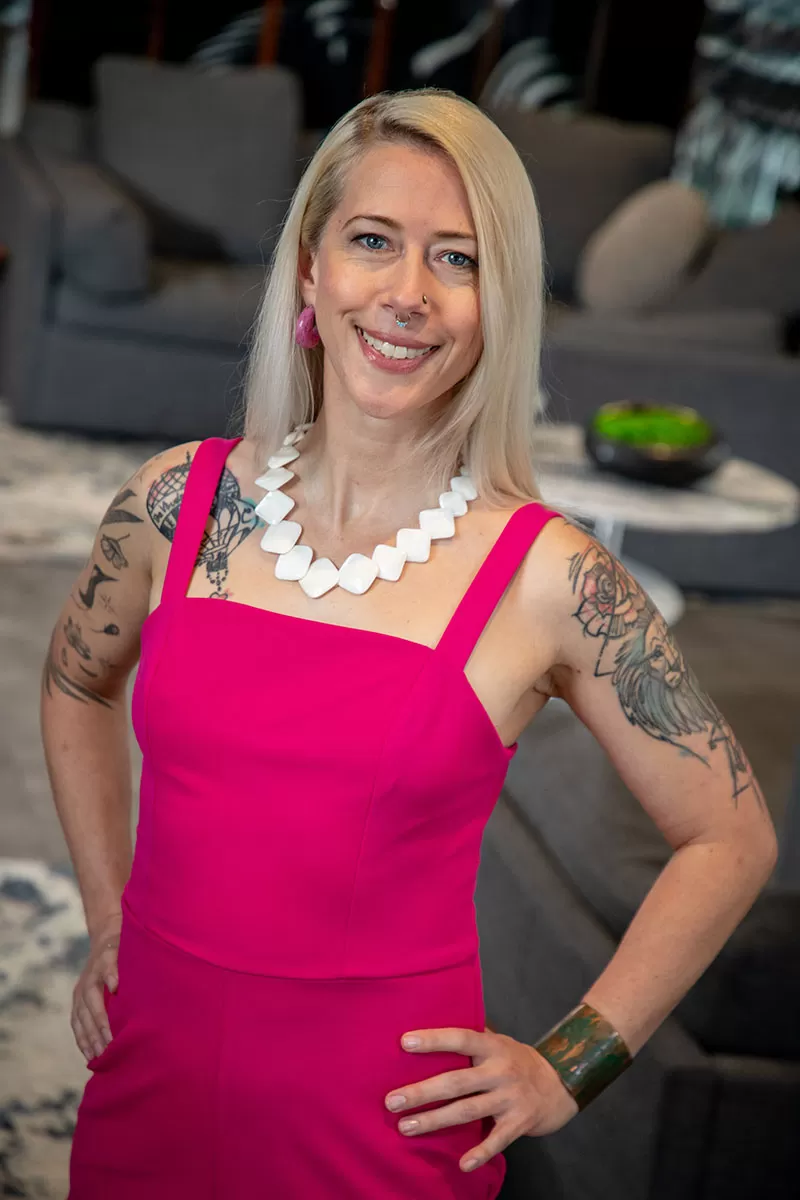
Laura Walker, RA, NOMA, NCARB, had no idea that she wanted to be an architect. She knew she was good at math and science, loved being creative—took painting courses and ceramics classes—but it took a chance encounter with another young woman who was an architect to discover architecture could be the path for her, that it could lead to the design of meaningful places that celebrate culture, prosperity, and creativity at the intersection of public art, architecture, and interior design.
“I didn’t really know what it meant, but it was cool to see another woman saying she was an architect. My friend’s dad was an architect, and he took me to the Lawrence Tech Library. I went to the architecture section and was just amazed by what I saw, and that architecture could be cool, could be fun. It looked really interesting to me, but it wasn’t something that I knew I always wanted to do, and I didn’t really know what I was getting into, it just seemed like the right fit,” Walker said.
“Architecture was hard for me. I felt like it was a huge learning curve in terms of learning the technical aspects, all the things you need to understand as an architect, and there is a lot of complexity to it, but I really enjoyed it, and I felt like there was a lot of meaning to it. I felt like I had a purpose in designing spaces and I really dove deep into it,” Walker added.
Walker attended Lawrence Technological University in Southfield, Michigan, where she received a Master of Architecture degree. It was during her studies there that she discovered her passion for both the academic and practice sides of the field, noting that her love of research, architectural and design theory, was what drove her to stay involved in the academic setting long after graduation. Today, a practitioner and an educator, Walker has been both architect and adjunct faculty member, and design architect and lecturer, at firms across Southeast Michigan and institutions like her alma mater of Lawrence Technological University and the Taubman College of Architecture and Urban Planning at the University of Michigan in Ann Arbor, Michigan.
“I love teaching. It is one of the most rewarding things. I leave studio just feeling really uplifted and inspired by my students, and it is a form of advocacy for me. When I was at university, the teaching style was brutal, overly critical, and a lot of agendas involved, and so I try to bring a fresher lens and really open the minds of my students about what is possible for them in architecture, because there are so many different avenues you can take,” Walker said. “Figuring out what brings each student joy and what they are interested in, harnessing that, tapping into that, and guiding them toward being okay investigating something they might think is silly—which I don’t think is silly—is worth it.”
Her work in the academic field dovetails with her own practice, in which the firm’s self-admittedly unconventional approach to architecture is a demonstration to her very students that there are possibilities in architecture, that “you can be a woman and own a business,” and that design philosophy can embrace joy-driven work that uplifts people and communities. Other Work, which was co-founded by Walker and co-founder Michael Styczynski, architectural designer, embraces the playfully critical, celebrates the value of the margins, and is committed to supporting local businesses and residents through work that promotes liberation, joy, and agency. Its work is aspirational, vibrant, and true to the existing stories and counternarratives that exist in neighborhoods and place. It is fun and joyful, but more importantly, it is about good design that reimagines and radically affirms and celebrates human identities, expressions, and desires within participatory environments that change and transform with people.
“My business partner and I met teaching, both worked at this large corporate firm, and in 2018 we pursued a design-build competition, and it was the first time we had worked together in that capacity. We would sometimes have the competition work up on our screens and our friends would say, ‘Is this the corporate work or is this your other work?’ We kept ‘Other Work’ because it was important for us to uplift and focus on folks who have been marginalized and othered by conventional society, by mainstream society,” Walker said.
“That is fundamental to how we practice and what projects we take on, we are always looking at how we fold other people into this or bring folks along with us who can affect the project in a really meaningful and authentic way,” Walker added.
Founded in 2018, Other Work portfolio features projects like its award-winning “Stitch City,” a community design hub and incubator that used reclaimed billboard tarp and integrated flexibility in which the City of Detroit municipalities could engage directly with community. The project was recognized as the winning entry in Detroit’s Design Center in a Box Competition.
“For us, a guiding factor would be, ‘Is this a project that really benefits the actual stakeholder of the project?’ Is it a project that has in mind the folks who are either in the neighborhood, in the community, or are using the space in a way where they are included in the process and they actually have something to gain? We also consider if this is a respectful collaboration among the client, among ourselves, among our whole team, and the constituents,” Walker said.
“Having respectful collaboration is one of our values and that pertains to how we are treated and how we treat other folks. Our focus is on relationships, that is a big part of how we have built our base, a network of talented creatives who are Detroit-based and who are mission-driven. We look at how it fosters relationships in a sustainable and creative way and how it impacts the constituents,” Walker added.
Other built projects in Other Work’s portfolio include Sidewalk to Utopia—a gateway that served as mediator, threshold, and expression of identity in 2019 to the Sidewalk Festival—”A Traveling Apothecary For Detra,” a community table, library, and medicinal tool; Shared Shed; and Shelter Bay Animal Hospital, among others. “Garden Novella,” as a project, was considered a traveling garden of stories, plants, and lights, featuring audio recorded stories from residents and business owners from Southwest Detroit. The Detroit City of Design award-winning installation was designed as an interactive and immersive soundscape choreographed to introduce visitors to the community—and highlights the firm’s thought toward how human bodies perform and interact in space, to place, through the celebration of culture.
“It goes back to what we are celebrating and uplifting in the cultures of the people in our neighborhood. We are based in Southwest Detroit, which is mostly Latino immigrants, folks from Central and South Americas, and also from the Middle East, and when you enter this neighborhood, there is reggaeton playing, there are all sorts of Mexican restaurants, like people come here for the culture, for the music, and for the food and the arts. There are murals everywhere,” Walker said.
“We did this streetscape installation focused on uplifting the stories of the business owners and the residents here in a way that was related to them as human beings and not as service givers—they are not just a chef or an educator or a musician—but more of, ‘What is their story?’ We wove it into this installation that we had paired with plants and with lights and the sound would activate when folks approached it, so folks or tourists could hear a bit of themselves in a story of someone who has a totally different background than them. It is a way that unites us a little bit,” Walker added.
Walker, who was named 2019 AIA Detroit Young Architect of the Year, has more than 15 years of experience in the field as both a practitioner and educator. She is passionate about advocacy, how architecture and design can be used as a tool to reimagine what is possible for the built landscape and strives to bring people into the process. Walker recognizes that the body is often the first point of reference one has in the experience of one’s given surroundings and the historical implications of a built environment—the inherent qualities and language used in vernacular that can leave many on the margins—can have a profound effect on whether one feels welcome or safe.
“That is really important in Detroit and it is really important in the United States. Most of the buildings and urban design of our country was and is done by men with a neoclassical, European reference point and that can make folks who aren’t in that category feel excluded or unwelcome or stand out in a way where you feel like you are being observed. And the history of disinvestment in buildings that were once iconic, speaks to the value that people feel as human beings,” Walker said.
“There is also a risk of people being left behind or displaced when it comes to the built environment and with new projects. There is a huge challenge in how we also interact with the folks in power who [transform disinvested spaces] and develop neighboring properties, how do we interact with them in a way that redistributes power and ensures that folks that have been here see some sort of benefit and participation in that rebirth. Everything is political in architecture, so that is a challenge we face with every project: how can we mitigate harm for as few people as possible?” Walker added.
She also noted another challenge, one she views as one of the biggest ones facing the industry, is that the role of the architect is often either misunderstood or not understood at all. As an advocacy-based, neighborhood architectural studio, Walker said raising awareness, engaging folks in a critically playful way, and collaboration with those involved has been integral.
“We’ve had times where we’ve brought clients into other projects as consultants because there are so many resilient, hustling creative people in Detroit who all have something to offer beyond just their day-to-day. Fostering that network and linking folks together is something that we really enjoy doing. Participatory environments and spatial agency play out both in the process and the way the building or the space is programmed and interacted with,” Walker said.
“We don’t view architecture as a way of controlling behavior or predetermining how a space is used. We see it as always transforming, always becoming something new, something different. It is really an interface that facilitates interaction among people, among non-humans, animals, and the environment, and with the building of the space itself. We look at how a space can support multiple needs and desires and how it can be flexible and responsive,” Walker added.
While Other Work fiercely advocates for its clients and community engagement, Walker noted the team is not trying to find that golden, magical design, but more so providing a design where everyone can give consent, knowing that not everyone will be totally happy with the outcome, but consent often means they understand the reasons behind the design—and play is a positive and constructive way in which to engage others throughout the process.
“It is disarming. I think when things are really serious and intense, we have our defenses up, we are in our rational mindset, and through play, through a system of play, your defenses go down because hopefully you are having fun. It allows you to be more creative and you interact with people and start to negotiate and play by certain rules and maybe test those rules, those boundaries,” Walker said. “It allows people to see the complexities of architecture, that there are so many different forces at work, so many things we have to negotiate and so many stakeholders who have competing goals or priorities.”
For Walker, who believes that architecture isn’t static, there is joy not only in her teaching and in her work as a registered architect, but also in the pursuit of possibility of what architecture can do and can mean to others.
“Joy is a huge part of how we work and what we try to seek. How can we bring joy to our designs so that it brings a sense of joy and upliftment to the folks who are in the space?” Walker said. “To me, architecture is the openness to change and transformation. It doesn’t have just one author or one designer but engages everyone in participation in its meaning.”