
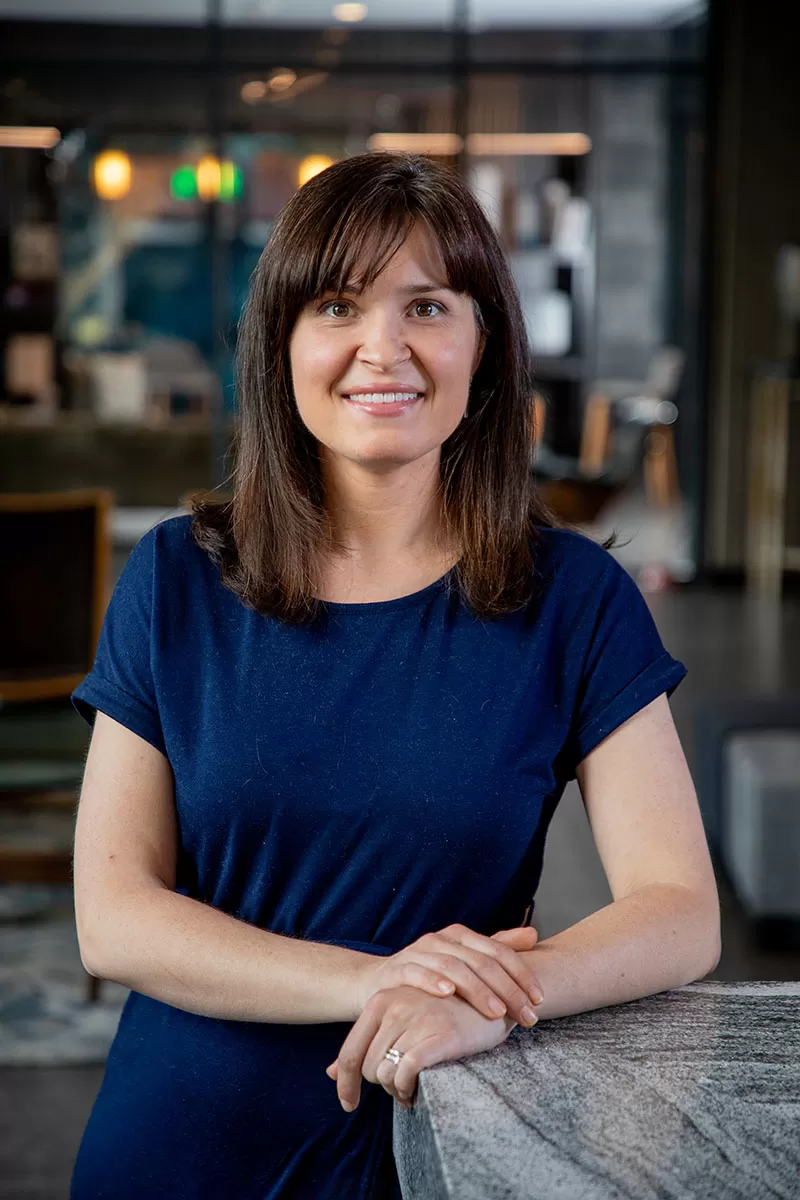
For Lauren Amt, AIA, design is meant to elevate life, to challenge thought, and quietly serve its user. It exists because it is needed and is about the community around it. Design is about communication, a tool and pathway that bridges the individual to the realities of the world, and it is that visual communication and its ability to capture the tactile moments and passions of people that initially drew her to the field of architecture.
“I do think design needs to be a quiet thing. I love a design that isn’t meant to shout about itself, it is serving someone, it exists because it is needed. I think it needs to exist for people,” Amt said. “And what drew me to architecture was the importance of visual communication. It is about producing sketches or something tangible so that people can understand what your mind’s eye is trying to communicate.”
Amt is a licensed architect in the state of Illinois and currently works as a project architect at the award-winning, full-service architecture, planning, and interior design firm of in Chicago. The firm, which has developed a portfolio of national and international work across residential, commercial, and institutional sectors, emphasizes collaboration and strives to translate their clients’ visions into projects informed by detailed study of context, program, technology, and budget. For Amt, who began her career at Bowie Gridley Architects of Washington, D.C.—a firm that specialized in master planning and design for K-12 independent school clients, higher education, and civic work, that has since joined DLR Group—Searl Lamaster Howe’s focus on communication and “presence of hand” that would ultimately draw her to the Midwest.
“I went to Syracuse University and got my bachelor’s there through their five-year program. I loved that the faculty was very varied. There were two schools of thought. There was an old guild that wanted you to learn all the traditional means of architecture, you sat down and learned how to draft on mylar, and then there was also the new guild that was interested in the more abstract aspects of architecture,” Amt said.
“They really wanted to use materials and touch things, or they wanted us to think conceptually about what people think about as they go into a space, instead of just saying, ‘here is the brick and mortar, we are going to have you put the pieces together.’ It was more about how does it feel to be somewhere or what does it mean to create a certain type of architecture?” Amt added.
Receiving a Bachelor of Architecture degree from Syracuse University in New York, Amt moved to Washington, D.C. where she spent her early career working on government buildings, higher education projects, high school and other academic buildings, laboratories, and athletic facilities. Amt said at the time, during the height of the 2008 Great Recession, she was really grateful to be at a firm that did higher education work and had the opportunity to work with the Library of Congress on a few projects. And after spending four years in D.C., Amt relocated to Chicago to explore hospitality work and eventually joined the Searl Lamaster Howe team in 2015.
“I know there are a lot of people who go into academia, but I really wanted to see my projects built. I went into hospitality, because I wanted to make a mark on the city and also create something intimate, where a single person was using the space. So, you would have these grand entries, but then you would also have these beautiful suites and that was fun to work on,” Amt said. “And that was when I discovered I enjoyed having that one-on-one communication.”
It was that process of communication, of sitting down with an individual client, getting to know them and building meaningful relationships over the course of a project that Amt found fulfilling with single-family, residential work. She noted the firm has developed relationships that then carry on into future work and have maintained friendships with those individual clients over the years.
“It’s exciting to make something with them, and it doesn’t feel like we’re just creating something that doesn’t have feedback. And the fact that [Searl Lamaster Howe] is aligned with me on the sketching, that presence of hand, and having that communication where you sit down with someone and have time and people who are interested in that kind of communication, really pulled me into the firm,” Amt said.
“None of our projects that we work on can be put in one spot versus another, it’s designed for that space and that person. I’m glad that I work at a firm where every single project is so specific to every person, and we don’t go in knowing what is going to come out of it. I love the fact that you have good feedback before you can really create a space for that person,” Amt added.
Over the course of her career, Amt also spent two years as a project architect at Rowland+Broughton Architecture and Interior Design in Denver, Colorado, a firm specializing in the embodied connection between people, place, and culture across residential, hospitality, commercial, cultural, and historic preservation work. While in Colorado, Amt worked on the Resnick Center for Herbert Bayer Studies, or The Bayer Center, and the Aspen Mountain Club, before returning to Searl Lamaster Howe and Chicago in 2021.
“I think because it is such a small firm, there is always something that will challenge you. It is helpful for me to get out of my headspace sometimes. I like the fact that our projects are often stacked so we have a lot of variety in what we do, and I also like the fact that the firm is willing to put you in a position where you get exposure, instead of holding your hand through everything,” Amt said.
“Firm owners Pamela Lamaster-Millett and Greg Howe take the tack, ‘We know you understand the concept, you’ve seen us do it, you’ve been hearing what’s happening in the studio, let’s see you take a shake at it.’ It’s a great firm in that there is a lot of room for growth, and I never get tired. I think, too, you always have people to talk to if you ever get stuck, there is a lot of support even though it can be overwhelming when there are so many new things you are tackling,” Amt added.
For Amt, that support is critical in the profession like fostering excitement in the field for aspiring young architects and students and beyond, and has led to her involvement as a panelist and mentor through the American Institute of Architects, or AIA, and in programs like Architecture in Schools. As an independent, nonprofit, and student-run organization, AIS is dedicated to advancing leadership, design, and service among architecture students. Amt said when she was younger, she was introduced to architecture in high school and found she really wanted to hear directly from architects.
“I mean, when I was taking this program, it was more of just this is what drafting is and this is how you show someone that it is three dimensions. It wasn’t an architect coming in telling you what their day-to-day was like or explaining the client-end of things, it was more about the nuts and bolts. So I think AIS is really nice, because they expose students to it, they bring you into the firm, they show you what it is like to sit at that desk or meet that client, or be on that job site,” Amt said.
“It’s a lot more personable and I think it is important to show someone what you are passionate about. Plus the students’ creativity is unlimited. They have no preconceptions; they just go in there with curiosity and excitement. It helps you see things anew and, it helped me think on a different level as well. It was something I looked forward to every time I did it,” Amt added.
While noting she hasn’t participated in that specific program in a few years, she has also more recently been involved with AIA Chicago Third Thursday, which is a networking program that brings professionals together to explore innovative themes and showcase groundbreaking work of fellow AIA Chicago members. Currently, she serves on the host committee as co-chair alongside Joe Cliggot, AIA, of HKS Inc., and is able to help shape the program, which has been fun for her to move into different spheres, learn about architecture in different ways, and celebrate the city and the people who are helping shape it.
For Amt, who noted the decline of highly skilled craftspeople in the trades is definitely a challenge—one that coincides with the rise of machine fabrication and AI-related challenges—there are opportunities in technology that remain. And her hope is that those opportunities can be used as a tool by skilled practitioners to continue delivering spaces and built work that evokes meaning and an emotional response in those who engage with it.
“To see it as a tool though rather than something that replaces a person. If you get a really great mind or craftsperson paired with a really great tool, you will end up with something phenomenal. I hope architecture takes advantage of it and doesn’t shy away from it, but we also don’t want to go full-throttle and give up on everything that was built before it and all the knowledge and skill that led up to it,” Amt said.
“I hope that people continue to want to create spaces that last. We are in a country where we have land, although there are some areas where there is density, and you are seeing single-family homes being turned over to build-to-rent spaces or places meant for more temporal use, and I think the spaces aren’t being built very sustainably or thoughtfully. I think we need to be careful about the stock that we have out there, that we aren’t taking away quality and replacing it with something that is not. I want our society to be well-positioned both with quality and also with expression, of who we are instead of something that is just a box that someone can live in, something meaningful that shows a mark of history that we want to make for our generation,” Amt said.
It is about curiosity and the creative mind, about imbuing soul into the spaces people inhabit and engage with, and creating something that is meant to last, and that people want to spend time in, according to Amt. And in order to give it soul, one has to be open to the creative process, to curiosity and thoughtful exploration, rather than forcing or pushing it into a preconceived box.
“It is how we evolve. It is how science works, too. You test things and you touch it and you turn it around, and try to see what comes out of it,” Amt said.
“I hope my work is something that makes a person experience the world in a way that they can think fondly back on. I grew up in a beautiful home and my childhood memories were shaped by these spaces. I remember in college walking down the marble stairs that have been worn and kind of dips where all the feet have fallen. Those tactile memories are what I hope to give to people. I hope my contribution ends up capturing those things and capturing the passions of people into a space that they can love for a long time,” Amt added.