
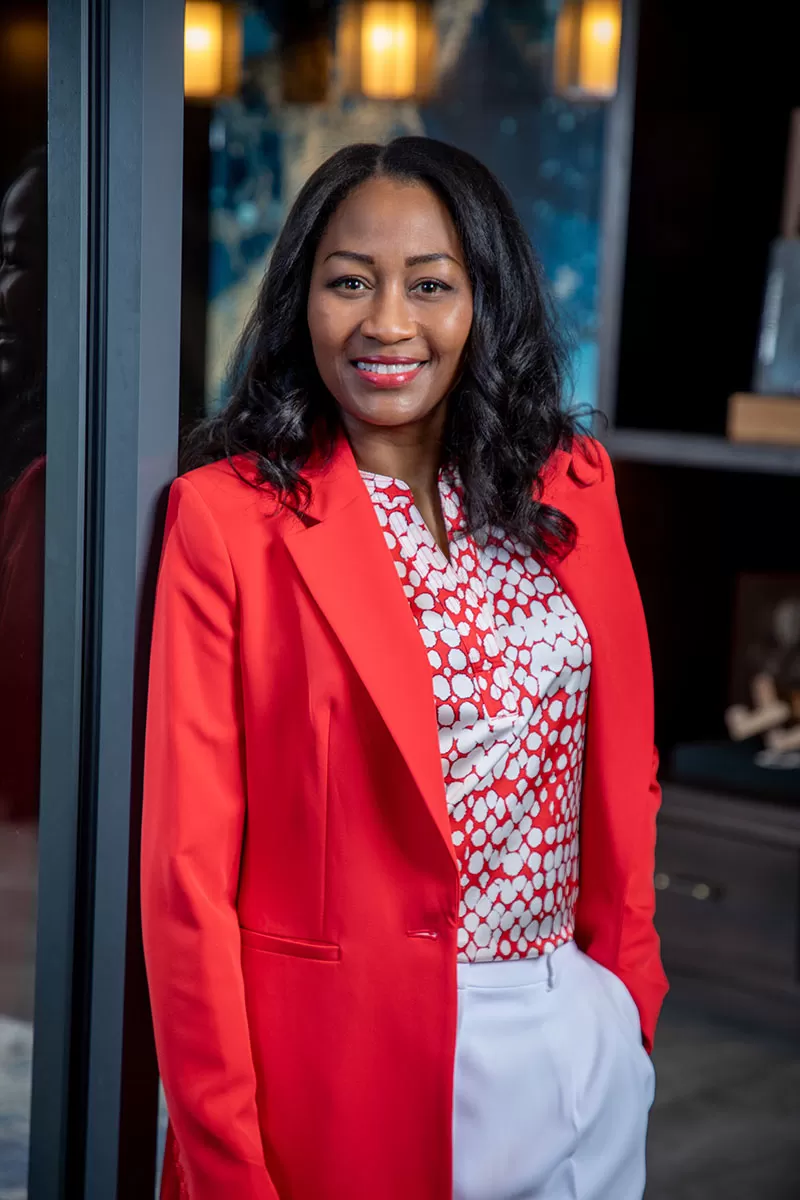
Marie Arrington, Assoc. AIA, NOMA, believes in community. She believes in its importance, in its vibrancy across diverse cultures, and in its ability to serve as home for so many people. For Arrington, who has also spent much of her professional career in the acting and modeling world, good architecture embraces community engagement and is an opportunity to design for equitable communities that positively impact all. It is about creative solutions and designed spaces that not only support and deeply reflect community needs but also celebrate what makes them unique.
“My design philosophy is about embracing community and all the energy that comes with that. There is a vibrancy and culture in every community that is different from every other place in the world, but the common thread is designing spaces that respect and celebrate what makes that community special. That is an important element for me, and it’s why I love working on projects where I get to engage with the community, ensuring their desires are well-represented,” Arrington said.
“To me, community means home. It’s basically where we feel our best, do our best, because the people who are in our communities are extensions of our families. They make up our neighborhoods. We protect that, we uplift that. We want the best in it and around it, and I think our community is what we need the most when we are feeling our worst, so when it comes to architecture, I really want to respect every culture and community that I come into, and to respect that, you have to know it,” Arrington added.
Arrington is an architectural designer at , an engineering and architecture design firm, in Grand Rapids, Michigan. The firm, which has office locations in Michigan and New York, was founded in 1966 and has become a trusted name in design as it seeks to envision the world to come. For Arrington, who has worked on residential and commercial work over the years, the opportunity to move back into the role of architectural designer—combining her love of art, design, and engineering—is what drew her to the new position.
“Since I was about 12 years old, I loved taking things apart—nothing was safe in our house—but I just loved building things. I was always curious to see how things worked and liked to reverse-engineer them. My mom was very crafty and she shared that with me; she sewed, she made jewelry, she did everything you could think of that involved arts and crafts, so I think that part of my love for design came from her,” Arrington said.
“I thought of architecture as an opportunity to combine my curiosity of knowing how things worked and my love of art and making things. It was the form and the function that appealed to me. I thought, ‘Wow, I can build something and I can make it beautiful.’ All the things I loved as a kid, like LEGOs, building card houses, pillow forts and snowball forts; I could make a career out of that fascination,” Arrington added.
Arrington attended Andrews University in Berrien Springs, Michigan, where she was involved in the nonprofit organization American Institute of Architecture Students, or AIAS, and received a Bachelor of Science in Architectural Studies. She noted it was during her undergraduate work that she began to hone in on her dual interest in engineering and visual arts.
“During my sophomore year in engineering, I felt like I was still missing something and so I picked up a ton of art classes to fill it—ceramics, sculpture—and I actually got a minor in visual arts because I had so many arts classes. It was a signal to me that I really do love art, I really do love design and creating, so I realized architecture was the right call for me,” Arrington said.
Upon graduation, Arrington then went to work for a number of smaller firms along the lakeshore in West Michigan. For her, a Chicago and Covert, South Haven native, the lakeshore was home, and she enjoyed her time honing her skills as an architectural intern working on residential and commercial work. She also spent time in a similar role at Isaac V. Norris and Associates P.C., or IVNA, a general practice architectural design firm in Grand Rapids, led by President and Project Architect Isaac V. Norris, AIA, NOMA, LEED AP, whose interpretation of the “soul of architecture” embraces the client’s basic needs, plans and designs within parameters, and exceeds aesthetic expectations.
“Isaac Norris was a wonderful mentor. He is a great mentor to a lot of local architects, so working for him really helped me develop as the type of architect I wanted to be,” Arrington said. “After, I moved back to the lakeshore, I met my husband, I got married, and I started working for a construction company. It was a difficult choice at the time, but I decided to move away from firm work to start a family.”
Though she stepped away from full-time firm work, Arrington quickly realized it gave her a great opportunity to engage face-to-face with clients as a freelance-based architectural and interior design consultant for nearly 15 years. In that time, she was able to work on resort projects and beach homes, producing initial schematic designs and construction documents for residential clients, as well as pursue additional work in her earlier career of modeling and acting.
“It fed that artist in me, to have that creative media outlet. It was really helpful for me, learning how to engage with clients, because when you are modeling and acting, you are the product. You have to know how to present yourself well and presentation is key. I really credit it for helping me in presentation, community engagement, and my ability to engage with clients,” Arrington said.
As a Model and Actor with several agencies including Wink Talent LLC of Southfield, Michigan, Arrington has worked on film and television series like “Batman Versus Superman: Dawn of Justice,” “The End of the Tour,” “Gun,” and “Virginia,” and commercials for brands like Buick, YMCA, Bissell, Henry Ford Health System, Pure Michigan, DTE, Meijer, and Baker College. She also has done theater and runway work, and said it is a creative outlet she still pursues outside of her architectural career when the time allows. In 2016, Arrington decided to return to architecture full-time when she attended Kendall College of Art and Design of Ferris State University in Grand Rapids, Michigan for her Master of Architecture degree. She was active with AIAS and began working as an architectural project coordinator at TowerPinkster, an architecture, engineering, and interiors firm in Grand Rapids, before transitioning into her current role as architectural designer at C2AE.
“Being in this role has allowed me to get back to what I’ve always loved about architecture, and that’s being able to be inspired in design,” Arrington said.
Over the years, Arrington’s involvement in AIAS, which envisions a more sustainable, healthy, and equitable future through the empowerment of voices, ideas, and actions, reflects a deep commitment to advocacy and mentorship. She has since been active on numerous committees with the board of AIA Grand Rapids for several years and currently serves as a Chapter Director for AIA Grand Rapids. Arrington said her work with the local chapter has been a wonderful learning experience and an opportunity to get to know the architectural community in Grand Rapids and beyond. This year, 2025, also marks her fourth year working with the board, fundraising, working with foundations like the Michigan Architectural Foundation, talking with firm leaders, and advocating for students looking to pursue a career in the field.
“‘How can I help you, how can I push you along, how can I be your advocate?’ There is a story I tell girls I mentor that when I was in high school, I wanted to join the woodshop class, because I wanted to be an architect and I needed to know how to work power tools, but my guidance counselor said it was not really a place for girls, ‘Why don’t we just put you back in band again.’ It was the first roadblock I had come up against where I couldn’t do something because I was a girl. My family had never done that, so it really took me aback and it took me some time to recover, like, ‘No, that’s not your decision,’” Arrington said.
“I didn’t have the agency at 15 years old to push against that and now I do, so when I see young women, young men, or anyone in those positions, I want them to know that they have the agency to advocate for what they want, to be in the career that they want, and just go after it with no barriers. Mentorship is so important to me, and I love it, and sometimes people seek me out because they are like, ‘I see myself in you,’” Arrington added.
She also is passionate about providing opportunities through AIA GR that engages emerging professionals and associate members who are in the process of seeking licensure, since she views the path to licensure as one of the challenges in the industry. Arrington noted there are people who have been in the field of architecture for decades who aren’t getting licensed as an NCARB professional because they don’t have the right accredited degree or might not have the time to complete all of the exams within the traditional running clock limitation.
“There are so many people who work in the field for years and they just never pursue licensing because it’s pretty hard when you have a family or are 20 years into the profession and suddenly have to go back to school for years to get this degree,” Arrington said.
“NCARB has made some recent strides to remove some of those barriers, and one of those was a barrier for me as well, which was the running clock. You had limited time to finish all of your exams. I’m looking forward to more thoughtful conversations about removing unnecessary barriers that sometimes unfairly affect certain populations within the industry. In my personal experience, the running clock really distressed me as a mother, even when I had an equal partnership in my role as a parent,” Arrington added.
But she also views some of those recent changes and mentorship as great opportunities within the industry to expand the idea of what and who an architect is in the field. Over the years, she said she has been invited to different schools, job fairs, universities, and showcases, and while there are great programs like Project Pipeline—which was created to serve students underrepresented in architecture and adjacent professions through the National Organization of Minority Architects, or NOMA—there is always an opportunity to do more.
“I am acutely aware that there are less than 600 Black women who are licensed architects in the United States. That is less than 0.5 percent, so I think opportunities for the future should include expanding the idea of who an architect is, what they do, and the teams that they engage with,” Arrington said. “Being a part of the Great Diverse Designers library and displaying my designs in the Say It Loud Michigan exhibit was such an important part of my story as a woman and as a woman of color. It is essential for the growth of architecture to show that every designer is unique and has their own story to tell. The more the younger generations know about the profession and how they have a place in it, the future will open itself up to a more diverse population.”
For Arrington, design is always about form and function, but architecture is often about so much more. It is about making spaces that convey emotion when you engage with it, about the hair tingling moments when walking grand staircases, and about the appreciation of detail, of color, of history, and the people who interacted with it. It is about art, the curiosity and playfulness that comes with it, and the exploration of relationships between the body and form that improves how one engages with the built environment.
“When we look at the golden ratio in animals, nature, and the human body, those relationships are so perfectly divine, and in a world where we spend so much time in front of screens and indoors, finding a way to reconnect with nature within those spaces can be so beneficial to our overall health and wellbeing. And as my sons like to remind me, we need to ‘touch grass,’” Arrington said.
“When we look back at great civilizations, the architecture of that time tells so much of that story, just like the architecture of our time is going to tell our story. It is so important for us to push those boundaries, because finding better and more sustainable practices in design will help us solve problems that we are facing as a society today—like homelessness and affordable housing. It requires innovation and commitment to make what was once impossible, possible. It should be a record of not just where we are but where we want to go, and pushing those boundaries are only going to help us get there—and equitable, inclusive practices in design ensure that we as architects don’t erase the history and culture of a community, but preserve it and build upon it,” Arrington added.