
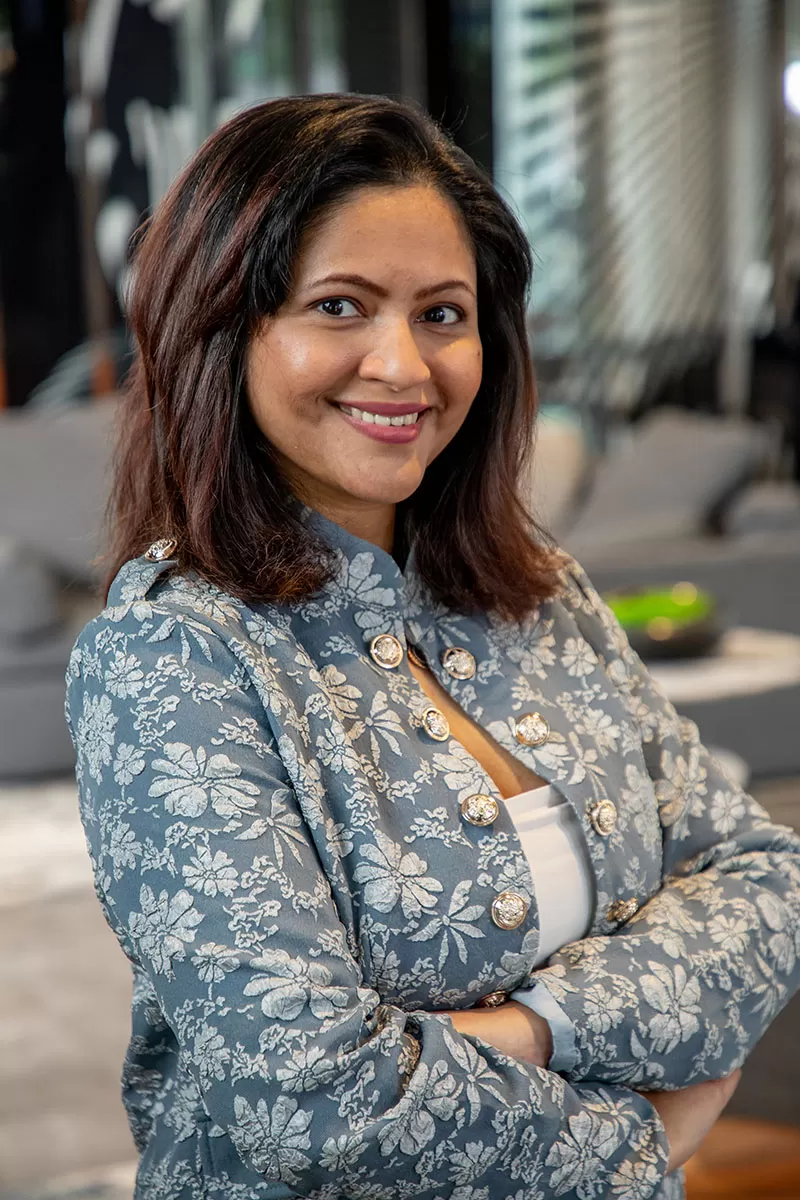
Shorf Afza, Assoc. AIA, is passionate about how buildings are made. She believes in the vernacularity of architecture and the thoughtful language used to deeply tie it to place, how healthy environments can significantly impact an individual’s life, and the potential of technology as a tool. It is in the use of technology in concert with one’s own creativity, ingenuity, and imagination she finds hope in the future of architecture. That it can deliver spaces that not only embrace complex geometries and biomimetic design but also support its users’ wellbeing—while recognizing the importance of building no more than necessary.
“When I was a bit younger and in school, I was always fascinated by biomimicry and parametric architecture and being in a school that taught both visual arts and architecture, I had access to all the fluid media. I liked designs and buildings that looked fluid-shaped, not box-shaped. I loved that. But then, one of my professors said something that changed my philosophy and thinking pattern which was, ‘build no more than necessary.’ In this profession, and in the age of global warming and inflation, I understand how important that is,” Afza said.
“I still think since we are very complex geometrical creatures in general that if our buildings mimic that, it becomes more useful. We also do have to understand that we have to build as little as possible and also get nearer to nature—there has to be a balance. So, my philosophy is mostly problem solving and make the built area less,” Afza added.
Afza is an architectural graduate with the WBE-certified, full-service architecture and engineering firm of in Indianapolis, Indiana. The firm, initially founded in 1976 and joined by the Louisville, Kentucky-based Arrasmith in 2020, is an integrated firm specializing in healthcare, higher education, K-12 academic, lifestyle, workplace, and community projects backed by roughly 130 professionals. For Afza, who first studied architecture at the Bangladesh University of Engineering and Technology in Dhaka, Bangladesh, Indiana was a deliberate move to complement her academic journey—and further foster a love of architecture first discovered when she was 10 years old.
“My uncle is an architect in Bangladesh, and he designed our house. I was fascinated by the entire process, and I would go to the site with him. Then I got very much into video gaming, like the Harry Potter games, but I was fascinated by the castle itself and what would be possible if we mingle technology with buildings. So that is why, from the age of 10 years old, I have always wanted to be an architect,” Afza said.
“I went to architecture school right after high school, for five years. The school allowed the traditional curriculum established by a group of professors from the United States back in the 1960s. They mingled technology and manual drafting, but we were not allowed to touch computers for the first three years of school. Nowadays, manual drawing and drafting aren’t practiced as widely in schools. Although I’m from the generation who started their careers with computer drawings, I am also trained in manual drafting,” Afza added.
Receiving a Bachelor of Architecture from Bangladesh University, Afza sought to quench her thirst for different software programs and innovative technology being taught and used in the architectural profession when she looked to attend graduate school. She noted it was the very fact that the J. Irwin Miller Architecture Program at Indiana University in Columbus, Indiana was so new that drew her to the institution as one of the first cohorts to complete the curriculum.
“It is why I applied there. There are other schools that are much older and experienced, but I applied to a brand-new school, because I felt that it would help me learn what I actually wanted. The lesson I learned from my undergrad was that old schools tend to stick to their whole curriculum for maybe decades, but new schools try to do something new,” Afza said. “So, I joined here and I think that was one of the best decisions I took in my entire life, because this school was very experimental.”
The J. Irwin Miller Architecture Program is based on the cross-pollination of architecture design and studio art. Its multidisciplinary curriculum pursues “innovation at the intersection of art and architecture,” and is designed to educate architects of the future through a balance of technology, science, art, and architectural principles. The three-year program was founded by T. Kelly Wilson, who previously held an associate professorship at Harvard Graduate School of Design, and is currently led by Daniel Luis Martinez, program director, assistant professor, and director of graduate studies.
“[Wilson] is also a painter, so he actually made a tangle between architecture and art and technology. We had to do six hours of painting and six hours of architecture studio, and it became so prevalent when we graduated, because now there is a whole section of students who are good in both mediums—and not just painting and drafting, but all sorts of medias. We had to finish the visual arts like a visual arts school would teach, and I loved everything about it,” Afza said.
Throughout her academic career, Afza also worked on graphic and architectural projects for the Bangladesh Police, Tippecanoe Arts Federation, Turning Point Domestic Violence and Sexual Assault Services—in collaboration with Professor Brittain Brewer—and LAA Office, co-founded by Lulu Loquidis, PLA, ASLA, and Daniel Luis Martinez, NOMA. She then went on to work at Browning Day of Indianapolis before joining Schmidt Associates in 2023. Afza, who is also passionate about helping young architects, has dedicated a lot of her time to that effort as Co-chair of the Indianapolis Young Architects Forum, member of the High School Architecture Design Competition Committee, and as a recent graduate of the AIA Indiana Christopher Kelly Leadership Development Program, 2023-2024 cohort.
“I do volunteer work, because I love it. I never thought I would be in a leadership position, never had the idea that I would be there, but when the previous president at Young Architects Forum was retiring, she called myself and my co-chair Logan [R. Gemmill, AIA] and asked if we would be the next leaders. Neither of us thought we would get to leadership this early, but she trained us and then I understood how much I could do,” Afza said.
For her, it was not only about guiding the AIA Indiana YAF program founded to address issues important to young architects such as job searches and the development of critical skills, but also about fostering a culture in which young and emerging architects can look to each other, colleagues, and mentors for advice, for collaboration, and for learning.
“When I came into the profession, I overworked myself and my mental and physical health went downhill. There was a shame involved, too, because when everybody thinks you know many things, but you actually don’t know, it is tough to admit it. I thought, if we can develop our generation where we can teach them that it is okay, if we can grow that mentality that even people with 40 years of experience might not know things, we can create an awareness that it is okay for it to be a learning environment, that everybody is encouraged to learn,” Afza said.
“We have to be more curious. The trend of personally doing research and study groups—not just to pass the ARE, but to study materials and new stuff we can do—is becoming less and less, because we are busy with so much other stuff. I really think if we can make a culture where this is a thing where we study about things together, I think we will advance very fast,” Afza added.
Afza’s work outside of the firm has led to her advocating on behalf of the profession at the Statehouse, educating political representatives and senators on the potential impact of certain policies to the architectural industry and beyond, and recognition as an emerging thought leader in the field as the co-winner of the 2024 AIA Indiana Next Gen Award.
“Historically, architecture is very related to politics. Kings made big pyramids or the Taj Mahal or big structures to show their might, but eventually it became so much more than that. It has intermingled with daily life, because what our senators decide, we have to abide by. If they say tomorrow that schools won’t get any government money, they have to do everything by themselves. For me, in a profession where I mostly design schools, it would be hugely harmful,” Afza said.
“We go, as part of AIA Indiana and Young Architects Forum, to the Statehouse each year in February and go through all the bills and see which ones are harmful or supportive to the profession. So that aspect, that we can actually help senators to understand how it affects architecture, how it affects industry, how it affects our basic human rights, it made me aware of things and how through AIA creates this awareness with the people in power,” Afza added.
For Afza, who is passionate about how buildings are currently being made especially in the Midwest as lower density allows for fast-paced growth, the practice of research and the practice of learning is critical to ensure each building reflects a deep philosophy and thought behind it. She also noted she hopes that technological tools like AI are used to support the architect, rather than leveraged as a means to imitate.
“Vernacularity is missing. Vernacular architecture should be designed for that area, for that space, for that climate, and the materials should be locally produced, which encourages local business. I’m very passionate about trying to think about ideas of how we can change that, because that would help us with climate change, too, to have a smaller carbon footprint and less energy usage,” Afza said.
“AI is very prevalent today, and I support using AI for data generation or specifying things, but I’m really not sure that AI should be used for designing, because it is copying from multiple sources. It is copy and paste, and there is no credit for the architect, why are we even studying then? In the future, I would like to see people using the latest technology, with their brain and with their imagination,” Afza added.
Afza hopes in the future that with all the advanced technology at the industry’s fingertips from CNC routers and laser cutters to software programs and innovative materials, that architects will prioritize the creative mind and imagination while consciously using technology to get there, rather than relying solely on AI prompts. For its significance goes beyond just delivering a successful, deeply contextual, or aesthetically beautiful building, rather to the influence the built landscape and a healthy environment can have on a child’s cognitive development and a person’s physical and mental health.
“I think landscape defines our brain. My uncle used to tell me that architecture is a habited building. It actually shapes your brain, our mentality or thought processes, a lot and I want healthy buildings. We need technology and architecture to work very closely together, because it confirms our wellbeing and develops our brain. If a kid is born in a healthy environment inside a building—they open their window in the morning, they see a beautiful natural landscape, they get enough sunlight—both physical and mental health are supported,” Afza said.
“With global technology and design ideas, we have to build that kind of building which provides us everything that we need both naturally and artificially—because we can’t live outside due to the harsh weather of climate change although it would be good for our health—creating an environment that provides what we need from nature and for that we need architecture and technology together. Design is a habited building and design is healthy living,” Afza added.