
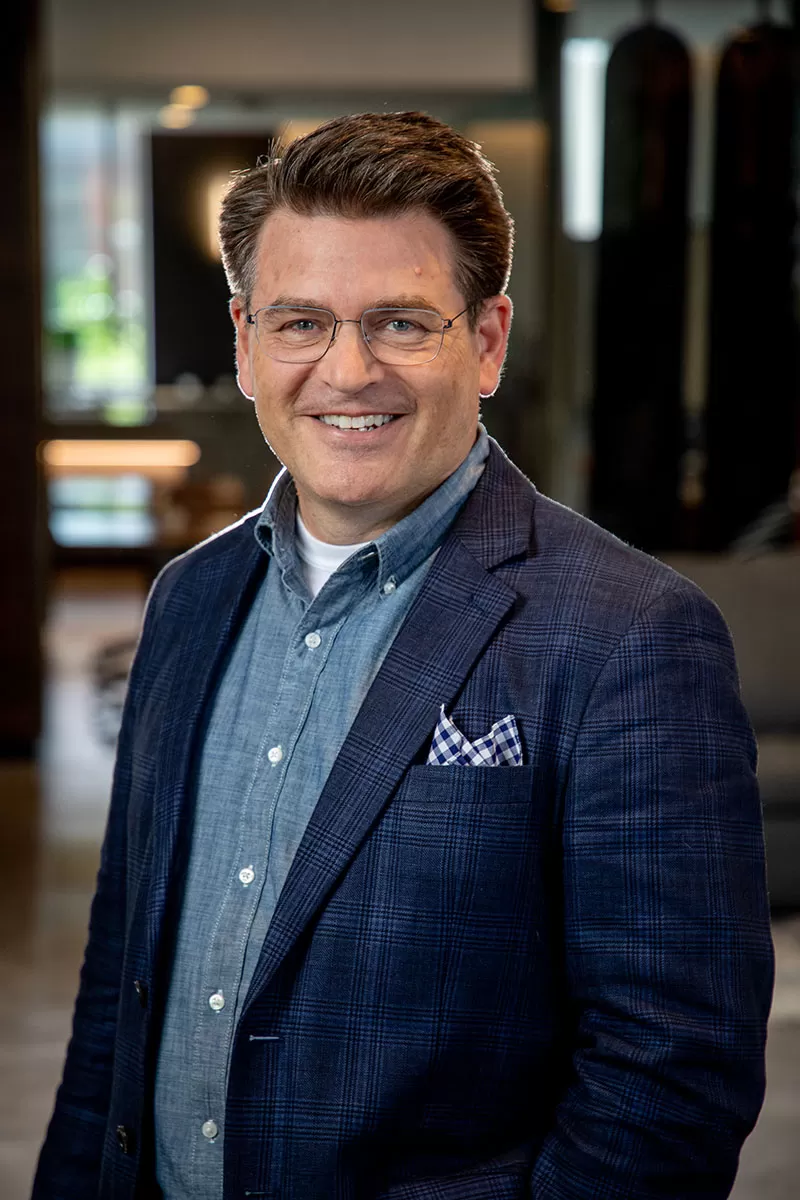
For Todd Hansen, AIA, CID, beauty is the highest expression of form and function. It is less a finite definition and more of a never-ending pursuit toward a perceived universal good, in which things like delight, harmony, and human aspiration inform spaces and places. To him, that pursuit is embedded in the thoughtful design of projects for clients, in which each home becomes more than a shelter, but also a cultural object with embodied values that is truly at home in the world and brings people into relationship with their surrounding environments and landscapes.
“Everything that is made, from a pair of scissors to a cathedral, is a cultural object, because it is physical matter somehow organized around function, appearance, and intention,” Hansen said. “I like that architecture persists in time and it shows us what being human is and has been. We are always striving, we are always pursuing something, always expressing our values for good or bad in one way or another, and we can’t seem to help it. It gives architecture, as a profession, the privilege of helping people create emotionally and physically satisfying environments that create place in the world. It sets humans in relationship to the bigger world. When you can do that thoughtfully and in a way that provides a spiritually sheltering, beautiful place; it is uplifting.”
Hansen, principal and partner at , or A&H Architecture, of Minneapolis, Minnesota, believes in the carefully considered relationship between a house and its natural setting, the life-affirming qualities of well-shaped and well-functioning spaces, and in the careful detail. It is through the language of form that people can interpret instruments, tools, and objects, like a home in the built landscape, as an embodiment or reflection of values at both the individual and collective level.
“There can be many different, simultaneous, values that clients are hoping to have their homes embody. The experience of knowing how to help achieve those results, like where does it come from, what associations do things have, what connotations do different arrangements of things mean when they are combined one way or another, is a pleasure of the profession,” Hansen said. “Part of what is so fun about what we get to do is that we are asked to integrate all these factors: there are external forces—siting, relationship to natural forces, adjacent properties, cost of materials—and then there are the goals of the client, and then there is the history of architecture, and then there are questions that our firm is exploring as part of our work, into a coherent whole. It’s challenging, but very satisfying.”
Initially drawn to the creative arts, Hansen found a love for architecture through graphic design, art history, fashion thrifting, nature, and the culinary arts. He noted as a young boy, he loved to draw and was fascinated by the factors and details that differentiated one object from another, such as the model or design of a car or NFL insignias on football helmets.
“I also played with LEGOs, trying to reproduce things with that clunky square-edged medium, trying to figure out what made things look like they ought to, and I was also attuned to nature and specific plants, and the world around me seemed like such a vivid place,” Hansen said. “In the ’70s, I can remember wondering why some things looked good and beautiful and others did not, and I wanted to be on the side that made things better.”
In high school, Hansen pursued art and served as yearbook editor, fostering an interest in graphic design. He also designed and sewed clothes, thrifting with his friends and modifying pieces, and spent time working in restaurant kitchens—discovering a passion for cuisine, the techniques and cultural traditions within a specific type, and the spaces that were designed to support the culinary arts.
“I took studio art classes and a lot of art history at Colorado College in Colorado Springs, and I loved the materials and methods aspect of it. I liked how things were created and how people were making these changes, but I was not really interested in being an artist, or rather it wasn’t about me expressing me, it was about making the world better for other people and just trying to understand the world,” Hansen said. “Then, I took a year off to consider going to chef school.”
After working for a year in the restaurant industry, Hansen decided to go back to college, attending Hampshire College in Amherst, Massachusetts, which is where he took his first architecture studio class. Taught by partners of an architectural firm, Hansen said he felt like architecture was the combination of everything he wanted to pursue.
“It was a real profession. It had a long tradition, it is complicated, it surrounds us, and it seemed like a great thing to try to do,” Hansen said. “For graduate school, I went to University of Pennsylvania, and at the time, the focus was on modern architecture, but they taught with a very humanist position, and they also taught theory through the entire history of architecture, so we were exposed to the idea or the embodied values in buildings from the beginning of time. I feel like I had an education that has helped inform the approach of our firm’s work in that we are happy to engage older existing houses and old cabins as they are on their own terms.”
With a Master of Architecture degree from the University of Pennsylvania in Philadelphia, Hansen entered into the profession, practicing commercial work at a large firm before he decided to make the switch to residential architecture. It was here that he discovered his passion for the project scale, the attention and care put into the process collaborating with clients, and the act of providing shelter for people. He spent time in the academic field, as an adjunct member of the architectural faculty at the University of Minnesota from 1994 to 1999, and at several well-regarded firms in Minnesota. When he started to attract his own clients, he decided to partner with his now ex-spouse, Christine Albertsson, AIA, CID, NCARB, who launched the firm in 2000, to form Albertsson Hansen Architecture in 2002.
“One of the things we love most about our work at A&H is the opportunity to mediate and provide that sense of shelter, but in a culturally and spiritually relevant sense that is not just sheltering people in a dwelling, but it is also making that dwelling at home in the world, and making it feel like it belongs,” Hansen said. “That it belongs materially and historically and functionally and sustainably. That is why architecture is so complicated and why it is so enjoyable, you are balancing many criteria into some kind of resolution for people. It is such a pleasure for us to have the opportunity to do that for our clients every day.”
A&H Architecture is an award-winning residential architecture and interior design firm partly informed by Scandinavian heritage and New England sensibilities. Over the years, the firm has developed a portfolio of renovation and new construction work reflective of a deep passion for delivering projects that foster well-being, a connection to nature, and reinterpreting the past for the future. And Hansen said the chance and the confidence that people entrust the team with from their budgets and their time to their hopes and dreams inspires him.
“That we can translate from their set of goals into something that is going to be durable and beautiful and works well and is going to look great 20 years from now and still be meeting people’s goals. I think sustainability also involves things that are going to be durable in time in terms of appearance, not just function. It is going to be something that has lasting value, because it has been well-considered up front and it might not be the trendiest thing, but it is still going to look good and make its own case for persisting without having to be torn down,” Hansen said. “People know that when they see an old cabin or an old house, they say, ‘oh this is great, I want this,’ and so the fun part for us is to be able to include those things that create that beauty and excitement into new projects.”
Though Hansen is hopeful for the future of architecture, hopeful that there will be an ongoing rebalance of cultural and economic forces that allow people to live and create in places that sustain them not just in a purely functional sense but also in a deeper way, he noted costs continue to challenge the industry. While price increases in the last five years have begun to level off, the cost to build remains a barrier, especially when the commodification of values has driven a rise in some people thinking an architect can just string a house together from images without “an active transformation that brings it all together.”
“Architecture is a service that we design a house together with clients and their goals,” Hansen said. “The pandemic was very disruptive to our industry. It caused a lot of cost increases, due to attrition, due to people getting sick and not able to work—so there were literally fewer people building, which drove up costs as well—and due to all the supply chain things that happened with materials coming from halfway around the world, and the Canadian wildfires.”
Hansen also noted he believes environmental challenges are certainly real and getting worse, and figuring out how to make things more resilient and efficient are a priority moving forward. But, as a counterpart, architecture’s potential, or opportunity, in terms of residential work lies in the simple fact that people still love their homes. It is a desire for shelter that speaks to both the functional and spiritual needs of an individual and entire communities, which is something he does not see going away anytime soon.
“I think [architecture] is important, because it shows us humans’ deeply held need over time to express ourselves in rock, stone, steel, glass, grass, or reeds. It is not just enough to provide only the functional necessities, but there is a goal for more, and to be able to be involved in that ongoing conversation is deeply gratifying,” Hansen said. “We have the opportunity to see what past cultures have done because the Colosseum is still standing, the pyramids are still standing; it’s a record of embodied human values. I feel that when architecture is undertaken with values that we hold dear, it aims in that direction, it pulls your mind upward toward the best humans can be, or strive toward being, towards goodness.”