
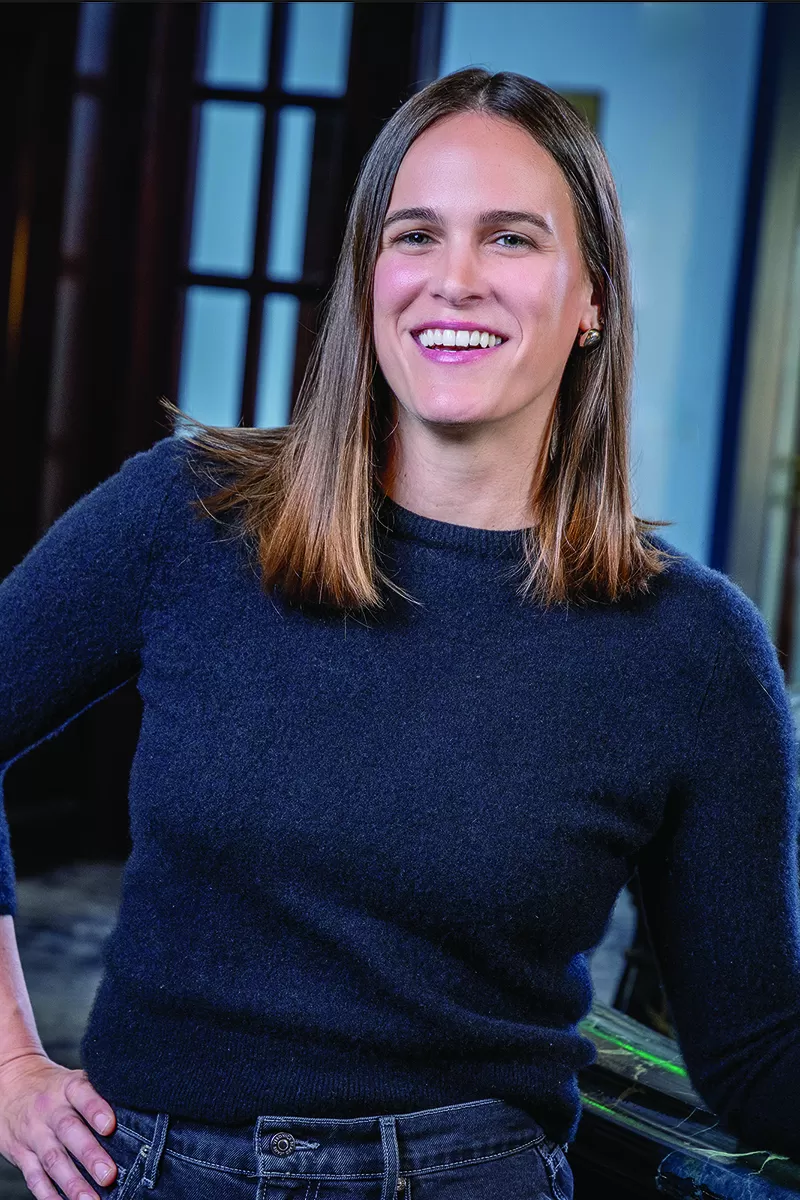
To Anna Pettinga, AIA, material and process are part of the connective tissue of the built world. It is in the curation of thought and form, of history and place, that a better designed world can take shape. For her, those connections extend beyond walls to the natural landscape, like in how interior spaces and the outside world can speak to one another, or how the materials used can create space and curate the experiences and the stories shared within them. Pettinga has a trained eye for art and views the architectural world very much like an artist, recognizing patterns and threads of process, of material, of culture, and of client needs that ultimately coalesce into a living tapestry intentionally designed to be just a little bit better than what came before it.
“I fell in love with the art world [in college] and it has had a huge impact on how I view architecture. That whole world opened my eyes to ways of seeing, ways of telling stories, and ways of thinking about materials, but I always liked having a problem to solve, which is one of the great things about architecture and design,” Pettinga said.
“Design is about paying attention: to how things grow, how they change, how people live, and how even small choices can make life and make our spaces more open and alive and connected. To me, architecture is all about connection. I like that simple term, because it bridges the huge variety of things that architects do: from the connection of building elements, how a line of sight grounds you to the site, and how a renovated building is connected to the history of what used to be there. It all ties back to connection on all different levels,” Pettinga added.
As Architect at Pure Architects in Grand Rapids, Michigan, Pettinga is easily inspired by people, nature, cities, and in the smallest details of daily life, finding creative curiosity in the liminal spaces between object and space and strives to be receptive to great ideas coming from anywhere. Founded by Zachary Verhulst, AIA, NCARB, NOMA, in 2020, Pure Architects is a JUST Company dedicated to creating uplifting spaces that make a positive impact beyond walls. Pettinga, native of Holland, Michigan, joined the team in 2024 and prior to it, spent a decade-and-a-half building her career in the architectural field as both a practitioner and educator—the latter of which began with a brief tenure as an English Language Instructor at Oe Dae English Academy in Gwangju, Gyeonggi-do, Korea.
“In South Korea, half my coworkers were expats—all of us carrying different accents, baggage, and a large dose of naivete into a culture we were still learning to respect and understand. Those coworkers told us early on that you couldn’t buy butter in Gwangju. Everyone nodded like it was fact. But a few of us stayed curious. We roamed groceries, stumbled through Korean phrases, and kept looking. And there it was. Butter. Tiny thing. Big lesson—for me,” Pettinga said.
“I think sometimes barriers are just what we’ve decided not to look for or ask questions about. Curiosity can find what certainty might overlook. And in our profession, asking questions and staying curious is in my opinion of the utmost importance. By the time I got to know the culture as much as I could in the time I spent there, butter was no longer on my menu. But kimchi certainly was, and still is,” Pettinga added.
Pettinga, who noted she always had an affinity for art and math, attended Calvin University in Grand Rapids, Michigan where she studied fine studio art and continued to foster an interest in architecture sparked from a young age. It was during a class project in kindergarten tracking the life cycle of a flowering plant that she took note of an adjacent pharmacy build taking shape next to the elementary school. It was a parallel, albeit distinctly unique process that marked her introduction into architecture and sparked a passion for material, for connection to the natural world, for process, and for making things a little bit better wherever possible. And years later, upon return from Korea post-undergrad, Pettinga attended the University of Cincinnati in Ohio where she earned her Master of Architecture graduate degree.
Pettinga spent time with HBRA Architects in Chicago, Ann Beha Architects in Boston, GBBN Architects in Cincinnati, and Gary Lee Partners in Chicago before taking on the role as Team Leader and Designer at King + King Architects in Syracuse, New York. While at the architectural design firm, Pettinga also worked as a Guest Lecturer and Adjunct Professor at Syracuse University. In 2018, Pettinga relocated to Michigan when she joined GMB Architecture + Engineering as an architect until she joined the team at Pure Architects in 2024.
“I’ve been fortunate to have been connected to great colleagues and mentors. It’s so important to have somebody who is a good listener, who can see you for who you are, and who can help guide your own professional development. That someone believes in you in that way,” Pettinga said.
“I had a professor in Cincinnati who I think almost everyone loved and who became a mentor of mine. He just had a very clear vision for architecture and was all about materials and the way that they connect to each other, and the story a structure can tell. He very sadly passed away a few years ago and so many people were touched by his life. He just had such a huge impact and had been an amazing designer, and on top of that, he was kind. He was a really good example of being the best at what he did but also encouraging other people. He was all about making architecture better together,” Pettinga added.
Pettinga’s perspective is that while she doesn’t design material, she does curate and organize them in a way that has a huge impact on architecture and space. She also said it is important to listen to clients and pay attention to how each project simultaneously exists within its own micro-culture and the broader community at the same time, so getting to know both and coming to the table with an open mind is critical to delivering a successful project each time.
“Then, there is the event of architecture, the event of the design process,” Pettinga said. “So, like who we are working with and what that experience is like for them is often something that is remembered, whether it is good or bad, and I think that is so important to us to really think about what that design process is, what construction is like, and how that affects community around it.”
She also thinks it is important to be honest with materials, where the honesty piece is about the earnestness of natural resources or manufactured products being true to themselves—unless one is adept at playing with the irony and subtle, tongue-in-cheek play of a material being used intentionally contrary to its truth. Pettinga said it helps to be able to see and understand the history and the change of a material, like wood, and how it can live and breathe, how the passage of time is visible within it, and how it can make a person feel connected to both space and the natural world.
“There is a local architect who introduced me to this really nice wood material a few years ago and it was such a cool experience, because we aren’t necessarily working with the same clients and he is someone I really respect. He was so excited, which got me so excited, and I was able to use a similar product on a project. It was nice to share a great material, and a design move even though we are not in the same office,” Pettinga said.
“Knowledge sharing is such a powerful tool. Architects need to be able to deeply understand our clients and their needs within the timeline of a project, and the more we share with each other the stronger our designs can be. And now with AI, people have easier access to all kinds of knowledge. I think this makes architecture even more about the process, the event of construction, and how well you listen. Also, as a working mom, I love outsourcing simple repetitive tasks and basic research to AI. Any kind of mental load I can free up for creative thinking and creative problem solving, I’m up for trying it out,” Pettinga added.
While the profession has also been challenging at times in terms of its flexibility for different working styles and people of different backgrounds, Pettinga is hopeful about the future of architecture. Even though strategies like sustainability have become laden with heavily connotated language, there is an element to it that has already shifted, in which the culture is less about adding technical features at the end of the design process, but rather integrating intention from the onset. And the variety of voices from different designers who make different connections through their way of looking at the world is something that should be celebrated, moving toward a more connected world to planet, place, and people.
“It feels like there are so many issues in our world right now that come down to deep disconnects. I’ve spent some time living in other parts of the country and the world, but right now I am most deeply connected to my roots in the Midwest, to Michigan, the Great Lakes, and the people here. There is an element of pragmatism to Midwest design that I appreciate, and I’m happy to work on projects that serve our local community, with people who can talk about our local resources,” Pettinga said.
Pettinga, who loves being outside, is able to find the humor in the fact she decided to spend her life creating indoor spaces that capture a little piece of “that freshness and openness and connection to earth” of the outdoors, and it is her background in art that has really shaped her view on process and material, and bringing that analytical curiosity to the subtle shifts and angles that can transform both into something new and different. She can find the connective threads between architecture and great works of art, like in the layers of paintings and paradigm-shifting photographs—and in the works that challenge convention, like Tom Friedman’s “Untitled” works.
“One of my favorite artists is Tom Friedman. He uses materials in a way that you wouldn’t expect, like how he turned 1,500 pieces of chewing gum into a sphere. But you think about all the energy that went into creating that, it is so different from a beautiful painting, it’s really about the process and material,” Pettinga said. “I know it’s a stretch to say this, but I think architecture is similar. Architects curate and organize plans, elevations, and details for all kinds of materials and how they connect to a site: and then someone else does the work of executing the building process. It’s a great collaboration; any way you look at it.”