
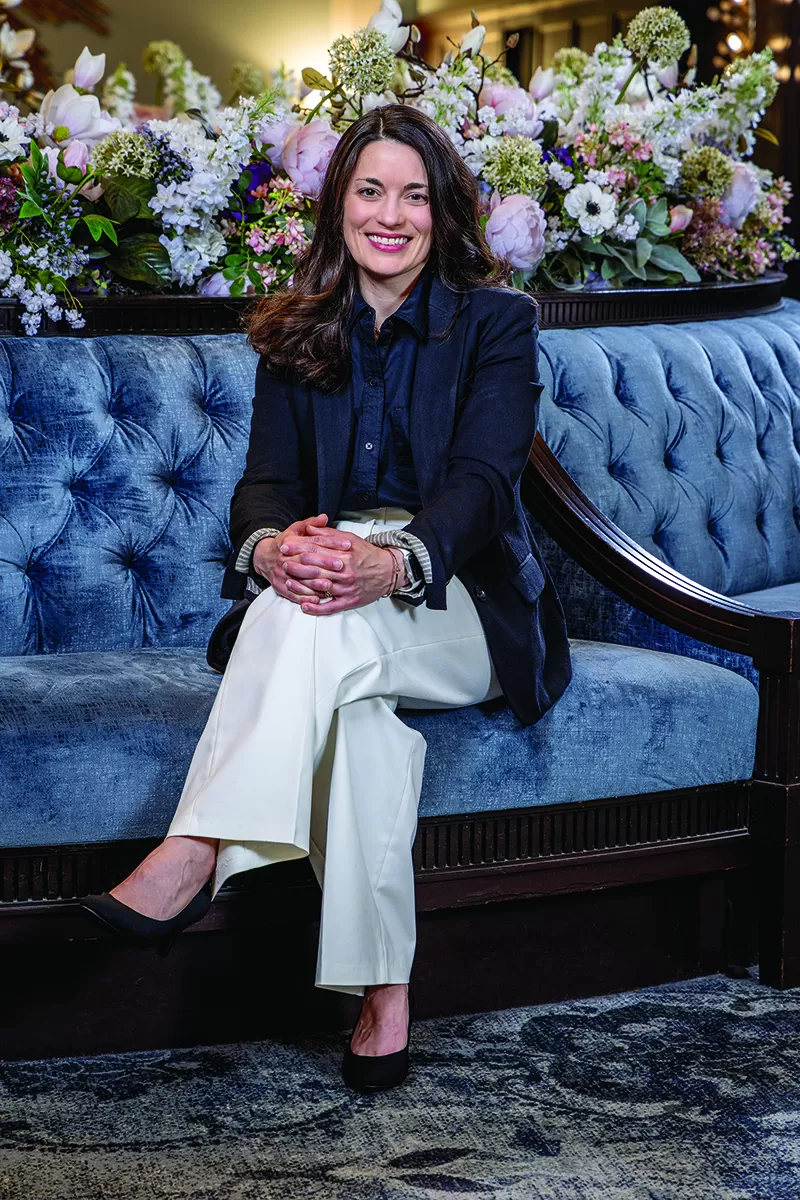
To Carly Camardo Drenth, details can often make or break a building. Details are instrumental in building relationships with clients, and that collaboration is an integral part of gathering information from co-creators—clients, consultants, and contractors. Curiosity throughout the process is also a key element to her to seek creative solutions that push the material envelope. In her role as Senior Project Architect at Integrated Architecture, Carly is no stranger to the details and the often complex series of information needed to bring a project to fruition, serving as a facilitator in that distillation point—collector, curator, and translator—delegating tasks and relaying those details to team members to ensure each project meets the needs of clients and communities.
“It is a lot of coordination—with the owner, with the team, with the consultants. A mentor once told me that a project architect role is a lot like an hourglass, in that all the information from the clients, from my teammates, and from the consultants, funnels through me and then I distribute that out. I enjoy being the project architect and being very involved with projects, serving as the point person who knows what needs are coming down the pipeline, and what needs to continue to happen to make sure buildings are being built right,” Carly said.
“I love the finished product—who doesn’t—but I think the process is important. It is so instrumental to be able to meet with a client, understand their needs, and go through that problem solving in design, with materiality, and building science. Some of the most influential teachable moments for me have been on the construction site, whether that was learning how to talk to a contractor or learning from them as to better construct a detail. I think teamwork and collaboration are vital to our field and unfortunately it has become more compartmentalized in some sense in that here’s the design, here’s the architecture, and here’s the build, and I don’t think it should be,” Carly added.
Carly, who has nearly 20 years of experience in the field of architecture, initially fell in love with it at a very young age when her grandfather gifted her a book that would help spark her passion for the industry. The book, entitled “The Architecture Pack” by Ron Van der Meer and Deyan Sudjic, invited a three-dimensional exploration of architectural landmarks across styles such as the Chartres Cathedral, the Sydney Opera House, and The Getty Center—as well as Renaissance palazzos, Palladian villas, and Chicago skyscrapers—with full-color foldouts, pullouts, and popups. For eight-year-old Carly, it provided a world of fascination, and reading about rhythm, geometry, arches, materials, and forms helped shape her love for architecture and the built world around her, particularly having grown up just nine miles west of Chicago.
“I was always fascinated with skyscrapers and buildings and city life. I would often ask my parents to take a drive just to go look at all the buildings. There was just something about Chicago and architecture, I mean, I grew up there so it’s still one of my favorite cities in the world,” Carly said. “My mother is also extremely artistic and creative, so I think I got a little bit of that from her as well as I have an engineering part of my brain. I didn’t know what any of that meant as a little girl—I just knew I liked to draw floor plans and grab furniture from my grandparents’ basement and rearrange my sister’s and my room.”
Carly took art classes in high school, but she noted it was when she signed up for drafting that she truly fell in love with drawing and the art of it. The class, while rigorous in its expectation for precise, clean lines—which shaped her love of a good line weight and sketch—also introduced her to a teacher, Mr. Whiteman, who she credits having a profoundly influential impact on her decision to pursue architecture later in life.
“He saw something in me that I didn’t even see in myself and helped steer me into architecture. He really encouraged me and when I could have graduated high school early, I decided to stay on with an independent study with him to continue to refine my hand drafting and prepare for architecture school in college,” Carly said. “It was that first stab at putting together the creative and the technical side, and it has not been an easy journey—I had a challenging time getting my architectural license—but I’m grateful for all the opportunities and adversities.”
She went on to study architecture at the University of Illinois Chicago, spending time abroad in Barcelona, Spain while continuing her graduate work at the university. It was an experience she credits for her growing love of cultures, food, and both old and new architecture as she studied history and architecture and structures across Europe.
“It was not my first time overseas, but I think everyone needs to travel, just to see different cultures and different food, and in this case it happened to be architecture—which is amazing in Europe and in Africa and in Asia—but Barcelona kind of pushed me to come out of my shell a little bit to be more confident as I walked into these buildings that are centuries old,” Carly said. “How did they think to come up with those? How did they get the boulders and the trusses? It was so eye-opening in a lot of regard—methodology, personality—so I believe everyone should travel if they can, even if it is just across town to get more perspective and appreciation of differences from what you may see every day.”
Carly noted one of the great benefits of doing both her undergraduate and graduate work at UIC was that all her professors were practicing architects who either had their own firms or worked for other firms in Chicago. It led to opportunities throughout her career, being able to build her resume early and network with professionals in the region at a young age while still in college.
“I stayed at UIC for grad school for that very reason, because it was giving me great opportunities and exposure that I might not have had had as a young 19- or 20-year-old,” Carly said. “I graduated in 2006 before the recession—which I learned early on how architecture kind of rides the waves of the economic times. And one of my first jobs right out of grad school was at Valerio Dewalt Train in Chicago, which is a mid-sized firm that exposed me to all the aspects of being an architect—3D model curving walls, rendering, construction drawings, customizing wine racks, picking out paint and carpet—and it really has been the backbone of my career since I was expected to do all aspects of design-construction and wear all the different hats.”
While at Valerio Dewalt Train Associates Inc. in Chicago—a national architectural and design practice with additional offices in San Francisco and Denver—Carly built an expertise in the commercial field and was also exposed to projects in hospitality and education, renovating interior spaces and complete ground-up build work. In 2014, she joined Gensler Chicago as project architect, where she spent the last five years of her nearly-nine-years at the firm as an architect working on large ground-up campus projects which she said really challenged her as a practitioner, navigating clients and contractors and exterior core and shell detailing.
“I like that I can help an organization or that I can help a school,” Carly said. “I mean, we’re problem solving for individuals and my personal philosophy is about getting to know them, asking good questions to understand what their needs are, how they want to work, and it’s a fascinating opportunity, ‘You are hiring me to do this, so let me get to know you better.’ I think it really comes down to understanding client needs and how it can start to inform certain rhythms and patterns, the materiality of it, and taking the constraints into account.”
While systematic and extremely attuned to the details, Carly is also inspired by nature and just how creative humans can be, whether that is from a simple walk outside or through an old architectural landmark.
“For me, sustainable design is just better design, better materials for a better world. We all play a part and if I can specify better products or materials that help my client in this built world, all the better,” Carly said. “There is a fine line of doing something beautiful and responsible for our world and the cost of it. While it is important to continue to push the envelope with materials and ground-breaking, creative designs, it is also important to be good stewards of our resources.”
To her, finding that balance is one of the challenges of architecture, creating a beautiful structure that also meets a timeline and budget. And it is in picking better materials, reusing old buildings, and investing in mechanical, electrical, and plumbing systems that support the longevity and sustainability of the buildings created in the world.
“I think that is where we have to continue to be learning and growing and have a pulse on all that, because our world needs to go in that direction and we have to lead that. But if we are not giving them a building they can afford, then we are not doing something right. Unfortunately, I think cost and timeline are hurdles we have to jump over. But I mean, that is also the opportunity,” Carly said.
“Do we need to change the materiality? Do we change the scale? They are all opportunities to continue to flex your muscle and with that you get stronger and sharper as a designer and as an architect as a result,” Carly added.
Carly, who has since relocated to West Michigan after meeting her husband in 2020 and working remotely while at Gensler Chicago, joined the team at Integrated Architecture in 2023 as Senior Project Architect. She noted when she sent out her resume to a couple local firms and heard back from Michael Corby, FAIA, president of Integrated Architecture, the response was almost immediate.
“I was hired within a week and my architecture journey to West Michigan began,” Carly said.
Established in 1988, Integrated Architecture focuses on sustainable, human-centered design and strives to build relationships with their clients in meaningful ways that ultimately impact the communities in which they work. The team seeks to discover each client’s unique story and deliver design solutions that reflect both current and future needs.
Carly is also thankful for the women who paved the way for her to have a seat at the table and hopes she can help continue to pave the way for younger women in the profession to go further than she did.
“We all have different perspectives, we all have different backgrounds, but if I can understand where you are coming from and you can understand where I’m coming from, then we can converse, and as a result of that being able to do something really cool for you is amazing, it’s a great job. I love that,” Carly said.
“The mind is just so powerful and so creative and faith for sure drives me personally, and looking to nature certainly fascinates me in how we can respond to that; how can we take that and continue to push the envelope in a way that is not just copy-and-paste, but how can I come up with that detail or that design in an inclusive, creative way,” Carly added.