
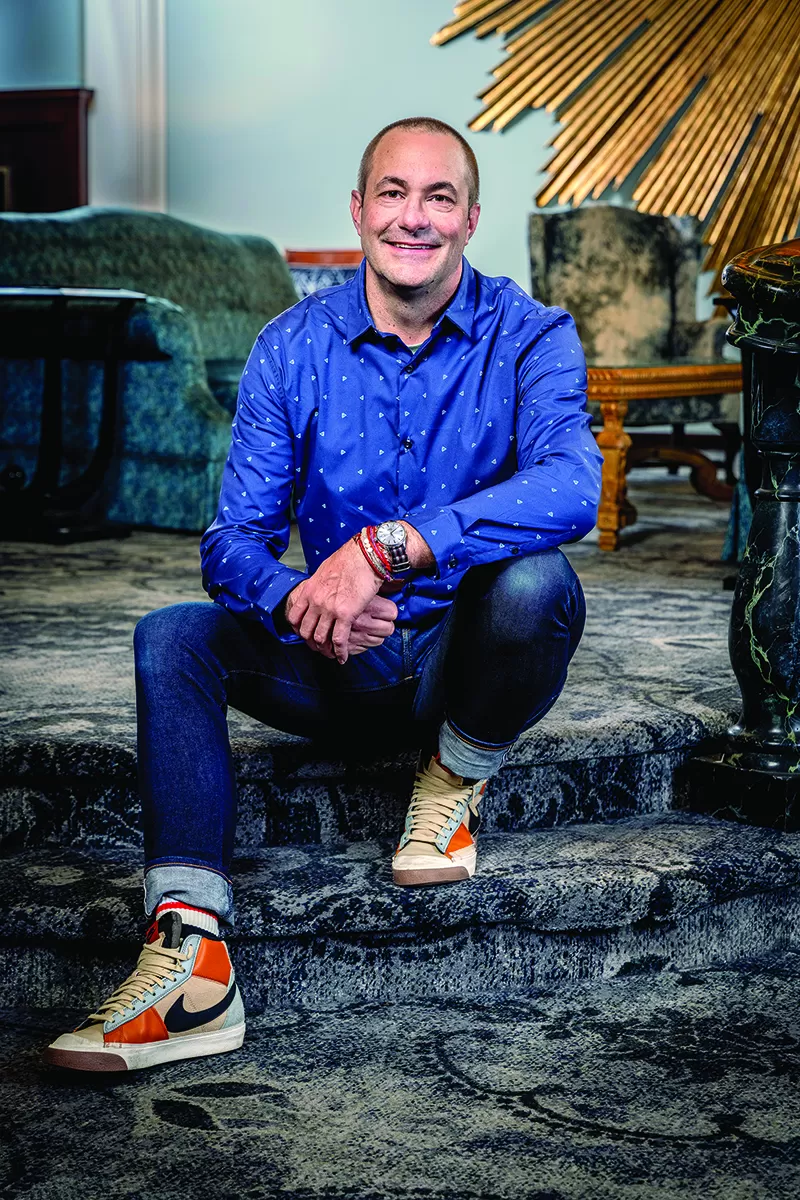
Jeff Klymson, OAA, AIA, NCARB, has been driven by the rigorous, creative pursuit of design his entire life. As the Founding Principal of Collective Office in Chicago, he is process-driven and detail-oriented, leading a team of architects and designers who are strategists and solution-seekers, storytellers at heart who are committed to a singular belief that a well-designed space can change lives. He is an educator and an author, and as a professional has designed over 300 projects across North America in residential, retail, workplace, and industrial sectors. For Klymson, whose practice initially began in Toronto before relocating to Chicago, his own path toward architecture began in a small town just east of Vancouver, Canada.
“It was kind of easy for me, because there were a bunch of creatives in my family. I moved from Vancouver to Toronto when I was about 10 years old and started getting exposure to the industry, which I think is when you really start paying attention to those things. My father was a builder-contractor who took me to job sites, my uncle was a published interior designer, my aunt was in real estate development—and I had another uncle involved in big public infrastructure construction with highways and bridges—so it was always kind of there,” Klymson said. “So, architecture just came naturally.”
Klymson, who started taking art and drafting courses in high school, also spent weekends and summers working with his father. It was while helping out with drawings and sketches that he would move through his very first zoning board of appeal process as a high school student, having worked on the drawings that converted a garage in a client’s residence into an in-law suite.
“They were hand-sketched with drafting machine, 11-by-17-inch paper that was presented to these committees for approval. It was all stuff you didn’t have to be a licensed architect or anything like that, but it gave me early exposure,” Klymson said. “It was always like, ‘I have to do this.’ So, I went to a very technical school in Toronto called Ryerson, which is now called Toronto Metropolitan University, for their very rigorous, four-year degree program. It was much more practical, and has a reputation for putting grads together who are useful at the desk almost from day one in practice.”
With a Bachelor of Architectural Science from Toronto Metropolitan University, formerly Ryerson, Klymson then looked to Chicago, where he attended the Illinois Institute of Technology’s College of Architecture and graduated with a Master of Architecture degree. At the time, in his mid-twenties, Klymson said he had his eyes opened a bit to the architectural world in the city—exposure to legacy firms and architects who continued to put world-class buildings out in the world—but had already long set to work, following in the entrepreneurial footsteps of family before him.
“Working for other people has always been about getting varied experience with the goal of starting my own thing. The first time I had my own company was when I was in undergrad, taking on my own clients, which evolved out of work I was doing with my dad,” Klymson said.
“I was working for other architects in Toronto, still doing some of my own projects in the background, when I ended up getting a pretty big interior project for a 30,000-square-foot gym facility. I ended up quitting my job, hiring some people to knock it out, and then ended up getting into grad school. I commuted back and forth between Chicago and Toronto almost every weekend, had a team in Toronto, and would be back in the studio by Monday afternoon. It was a lot, it kind of burnt me out,” Klymson added.
Though he took a brief break from firm ownership, relocating to the United States on a permanent basis, Klymson continued to practice as an architect, working at a local firm in Chicago before formally starting Collective Office in 2009. Born out of a desire to create a new kind of practice, one that was about the team of people required to make projects successful, Collective Office is about more than a single name on the door. It is about bringing everybody into the fold, in partnership, in co-creation, that had a long-term vision of creating an organization that would outlast its founding team. Its work, which has focus areas in residential, retail, and workplace, also takes on industrial and commercial work, specializing in creating spaces for life, that will endure, can support whatever unfolds, and allows people to be more present. The team creates spaces that uplift organizations and enhance the everyday.
“It is really about the process. We are also storytellers, which part of that backs right into the experiential value that a project wants to deliver. If you look at the entire process of design and you take the ego out of it and you replace it with the project, then the objective becomes the project not satisfying someone’s ego. The design becomes about the project. The process becomes about the project, and I think for the most part it is hard to argue against what a project needs,” Klymson said.
“So, if you get down to bundling all the people together who make the process and start having real questions and asking the project what it needs, then it is going to yield answers—which then becomes our process and the storytelling part of it which then delivers the experience that the project wants. If you take yourself out of it, and what we came up with is the most efficient for the most cost-effective way to achieve that, and it might be a different price-point than you are maybe willing to spend, the conversation can then shift to, ‘Where does the money come from that is needed here to achieve the experience and to deliver the story that space in the city wants?” Klymson added.
Some of its work includes the Honor Credit Union Corporate Headquarters in Berrien Springs and Timber Lane House in New Buffalo, Michigan; the Lake Geneva House in Wisconsin; the sophisticated mountain refuge in Park City, Utah; a Fullerton artist studio in Chicago; Hallstar in Bedford Park, Illinois; and major improvements for a warehouse-office building in Downers Grove, Illinois.
Shortly before launching his own practice, Klymson taught at IIT College of Architecture which he noted was a wonderful experience—and one that he finds reflective in working with clients, educating those new to the industry on some of the complicated, if not complex, nuances of a residential or commercial design and build process. For him, the project and the client are central in that process, and the team likes to encourage clients to challenge convention and push the envelope to take a design further than they thought possible—and over the years, led him to embark on what he said was “one of the most rewarding projects” he’s ever done with the publishing of his book, “Speaking Architecture: From Concept to Construction to Completion,” by Rethink Press in 2023.
“The book is an anecdotal step-by-step account from project inception or acquisition all the way through commissioning or move-in, so it goes through design and then construction. The majority of our clients are so busy—and it’s a complicated process that we take people through just because of the sheer amount of things that you have to address. It is a lot of decisions, it is dealing with a lot of money most of the time, and some of them are not used to making decisions that have long-lasting consequences about architecture, design, and construction that are going to define your life or your business for years to come,” Klymson said. “So, this was designed to be kind of a reference for clients to have while they are going through this process.”
Intended to be “a primer and introduction that makes any architectural processes you find opaque clearer and more transparent,” the book shares steps to take to avoid common pitfalls, cuts through jargon, and introduces design language complete with a glossary and shares additional educational and professional information in its directory. Its content is structured into three, overlapping sections of Defining Your Project, Designing Your Project, and Building Your Project, offering tips and anecdotes from real case studies and genuine projects. Throughout, Klymson addresses topics like writing a starting statement, establishing a project team, practical thoughts on scheduling and budgeting, understanding the role of the architect, local permit strategies, design-build, and Living In Your Project. Put simply, it is meant as real-world, practical advice for those who want to get the most out of their experience.
“It was all these things that were rolling around in my head for the last 25 years, and I thought, ‘Why don’t I just make this into something formal?’ Those first 10 weeks were really rewarding. I have an eight-year-old daughter, she was like five or six at the time, and after she would go to bed, I would just sit down, put some good records on, and write at night. Sometimes, in the morning before she would be up, I would write again so I found it to be super rewarding to think about this a little deeper,” Klymson said.
“The real kick in the pants was from my friend who had done something very similarly in the real estate world. I was like, ‘I can do this.’ And it was designed in concert with the rebranding of the company, updating the language that we are using, and graphically with the colors and fonts. It was designed to be a companion for the practice,” Klymson added.
Klymson, who has had his pulse on the industry for much of his life, said that there has been a great deal of uncertainty introduced into the industry in recent years, which has caused market shifts and increased competition for certain projects, particularly in the Chicagoland region. While industrial seems to be moving along as people try to react to a push for more of a footprint in the country—companies that have greater reach are moving and retracting more of that global reach into domestic borders—retail and workplace are still shifting and adjusting to new economic and physical norms.
“I think people are going to have to be a lot more creative about how we go about this business,” Klymson said. “We’ve started to do more industrial work, and I think the industrial sector is still there, which may or may not be a reaction or outcome of this direction to move more things back to the United States. I think there is a lot of confusion happening, since like five years ago the entire world was pushing more global and with the digital nature of the world, with AI, there are no borders, there are no boundaries.”
Though unsure how long the uncertainty and fluctuations in the market will last, Klymson hopes there is a full reset when it comes to the future of architecture, particularly when it comes to an appreciation for architecture and design and just what it takes from a creative, technical, structural, and engineering standpoint to bring complex projects to life. That there are certain skills and inherent talents that are required—a three-dimensional understanding of scale and the ability to visualize it, not to mention the time and effort that goes into communication, scheduling, and organization—by practitioners that are not easily replicated outside of the field.
“It was an ancillary hope for the book, to help people understand how much architects and designers actually do,” Klymson said. “How can the world pay more attention to what it takes to do this? How do you reset people’s understanding and perception of design? That to me is truly what would change the whole profession.”
For him, design is a way of life. It is a means of looking at things through a different lens, a more aware, respectful lens that when executed well creates the least amount of friction in somebody’s story or in their experience.
“Design eliminates waste. Design eliminates friction. Design creates a better experience, and the craziest thing about it is—this is maybe the crux of the problem—people don’t recognize that, because they are going through a more frictionless experience,” Klymson said. “I mean, really well-executed—perfect is the wrong word, because as I try to teach my daughter, nothing is perfect—but the better something is executed, the less you are going to probably see it, but there are going to be layers and layers of thought put behind it.”