
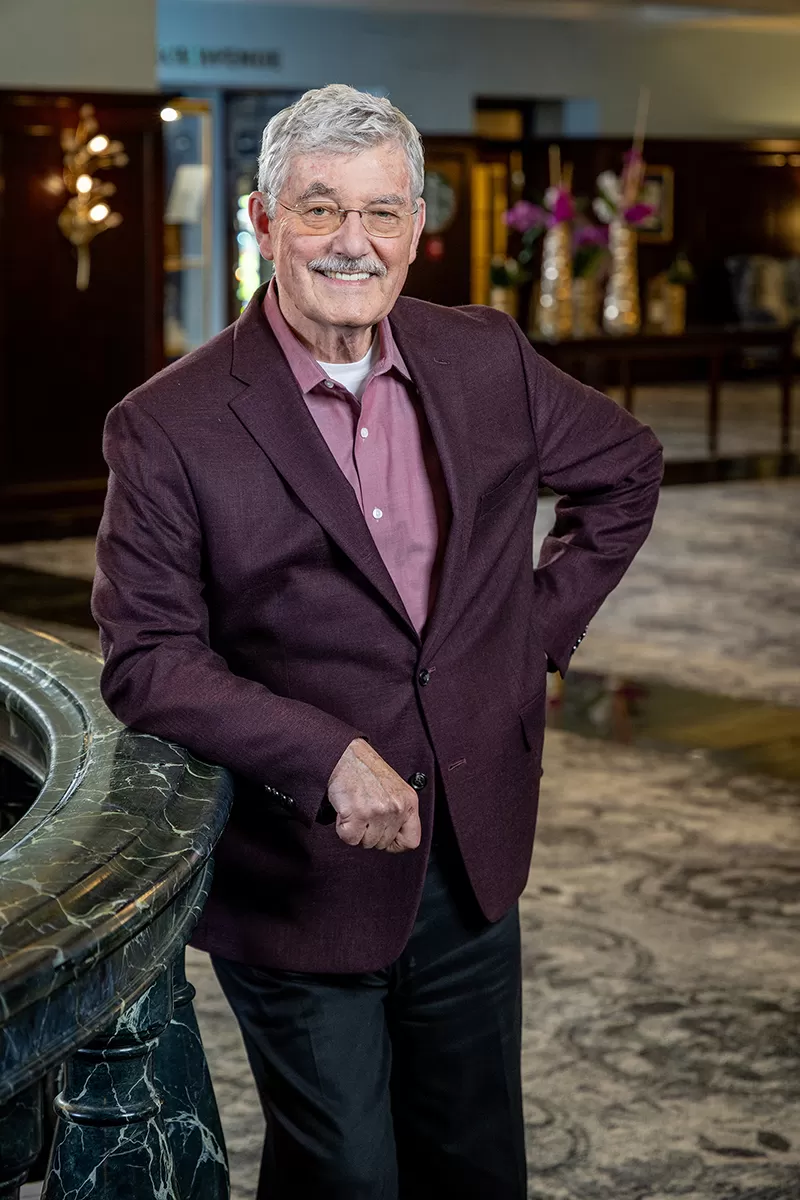
John Allegretti, FAIA, LEED AP BD+C, has spent over 50 years of his architectural career dedicated to service. His work, informed by the organic architecture of his mentor E. Fay Jones, like that of Frank Lloyd Wright before him, reflects fundamental design elements that harmonize with nature—natural materials, craftsmanship, and a sense of intimacy and tranquility. Structures are elevated as spaces imbued with a spiritual connection, and homes become places that uplift the human spirit. For Allegretti, who is passionate about creating places of shelter and of harmony, it is important that structures don’t sacrifice quality, sustainability, or craftsmanship in his pursuit to deliver work for clients that ultimately improve quality of life.
“I try to focus on my part of the puzzle, which is creating structure that gives people shelter in a way that is aesthetically pleasing, energy efficient, and meets the owner’s needs. Yes, the challenges are immense in this society, but the hope is that we all learn by our mistakes,” Allegretti said. “You have to create where we are going, why we are going, and what is going to be better about it.”
Allegretti has been the principal architect of Allegretti Architects Inc. since it was established in 1973. It is a firm founded on principles of service, sustainability, and excellence, with a team of architects and planners who strive to deliver best environmental practices and client-responsive solutions in harmony. Led by Allegretti, the firm’s portfolio reflects a love of the natural environment and a mission that views its work as a social responsibility, promoting affordable and sustainable residential design over the years.
Throughout his career, Allegretti has designed for Habitat for Humanity, Salvation Army, U.S. Department of Housing and Urban Planning, and been the principal architect for over 500 projects across the United States and internationally. Some of the firm’s work features residential projects in the Midwest like the simple shelter that tasked the team to integrate the compact home on a steep slope while celebrating its life-sustaining attributes; or the environmentally conscious, ADA-compliant pool house that featured wood tones, adobe accents, indigenous vegetation, and sculpted landscaping.
There is also the sustainably sourced pool-guest house that not only incorporated a garden, in-ground pool, in-ground trampoline, and pickleball court, but also an envelope that intentionally harvested rainfall to water the garden and feed back into the local watershed. The firm has also navigated sites wedged between critical dunes and nature preserves, and designed for Platinum LEED certification like with the 2,050-square-foot, two-story home in Grand Haven for clients whose previous cottage onsite had been consumed by the shifting dunes along Lake Michigan. That project featured SIPs panel insulation, energy systems, and roof shading with a mid-century modern reminiscent profile. It is a portfolio of work that reflects a deep love of the natural landscape and environment, which for Allegretti was fostered from a young age when his parents first purchased property in Michigan.
“My father was an architect in Chicago, and I grew up in Glen Ellyn, near the Wheaton-Hinsdale area. When I was about four years old, we came up [to Michigan] looking for property. As a child, my father had always gone to Shawano, Wisconsin with the family. You could wade out about a mile in the lake and it’s only up to your ankles. He and my mother found a parcel that they liked—this was 1950—and they bought a couple lots on Lake Michigan which were at that time about $50 a piece,” Allegretti said.
“Every year we would come up to Michigan from Glen Ellyn for the summer and weekends and enjoy so much time outdoors. I just loved the beach. I loved the trees, the natural surroundings, all the sunsets and sunrises, and the feel of the hot sand on the bottom of your feet when you run down the hill,” Allegretti added.
As a young kid, he said he also helped his father finish parts for a post-and-beam type structure over the winter in the basement of their family home in Glen Ellyn.
“They would call it mid-century modern today,” Allegretti said. “It was fun and I enjoyed being a part of that. I grew up working there and decided I wanted to be an architect. As I grew older, I worked in my father’s office before I went off to college. My grandparents, who I was close to and had retired down in Fayetteville, Arkansas, said I had to come down to Fayetteville, ‘There is an architect here, Fay Jones, who designs beautiful homes.’”
Allegretti, who initially had planned to attend the University of Illinois for architecture, building on the drafting classes and analytical geometry studies he had completed throughout high school, decided to visit his grandparents during his junior year spring break to learn more about this architect at the University of Arkansas. The architect who would eventually achieve international acclaim for his architectural and academic career was none other than E. Fay Jones. Allegretti said he ended up touring the campus and noticed that a number of architecture students were still working despite it also being their spring break and thought it very odd; which intrigued him.
“Wouldn’t they want to go out and have a good time? I was enamored. I said, ‘There must be something here,’ and at the time, Fay Jones was unknown to the world. Fay Jones was the creator of so many beautiful structures throughout the mid-states area and so I stayed,” Allegretti said.
Allegretti attended the University of Arkansas in Fayetteville, earning his Bachelor of Architecture and getting involved in the American Institute of Architecture Students, and spent some time after graduation in the northwestern region of the state. He then joined the Peace Corps and the U.S. Department of the Interior for three years in Samoa. While serving in the Peace Corps, Allegretti worked on a Contract Housing Government project in Apia, Samoa and a Low Cost Housing Government project in Pago Pago, American Samoa, which reinforced his passion for architecture and its ability to impact lives and quality of life. It is also where he met his future wife, Becca, which led to his transfer from Samoa to American Samoa.
“In Samoa, I worked on the public works department renovation project, master planning, and a museum for the community and various housing projects, and projects of that nature. Then, after a couple of years, I visited American Samoa, met my future wife, Becca, moved to American Samoa, and six months later we were married,” Allegretti said. “She was teaching school, having gone to Mount Saint Mary’s in California, and was involved in a lot of projects at the time—but I hadn’t taken my state board exam yet—so we decided to move back to the States.”
Allegretti worked for his father for a time while he took the state exam in Illinois, before relocating with his young family to southwestern Michigan. He then worked at a steel company, working on fabrication drawings, and after taking a job down south to design a high school in South Bend, decided to open his own office.
“[Michigan] is where my heart is. It is such a beautiful place, and we had our first child so the three of us headed up to the cottage in Sawyer. After two years, we built a passive solar, three-story home with a big garden inside replicating the Samoan environment. The garden area had a dirt floor and the handrails were planted—with sloping glass for winter heat gain,” Allegretti said.
“I opened up my own office in the house for a few months and then thought better of it. That is when we opened an office here in St. Joe. We are right on the lake, it’s a beautiful community, and this was back in 1975. We kept working on homes, did a few renovations, did whatever for about four or five years before finally becoming established and have just continued to this day. I’m just driven by the love of seeing things built, helping people realize their vision, and doing what I can do to implement that, to help them. And we’re still here,” Allegretti added.
Guided by a design philosophy for the last 50-plus years that it is not about the architect, it is not about the designer, but rather it is about the clients and humanity, Allegretti Architects is currently a full-time firm of six plus its team of consultants. Allegretti said he believes in helping people and doing the right thing, especially when situations arise where a contractor or collaborator on the team might be looking at profit over delivering homes and buildings that truly inspire people at their core, and have purpose. He noted it is important to build a good team around him, and make sure that a project, a client, or a vision the team takes on is compatible with their ethos.
“It gets tough too, because we continue to have an overload of projects and I’m trying to figure out how to pare that back. I like to spend a lot of time on a project, which is not very cost-effective as far as running a business, but it is what makes better usable and aesthetically pleasing spaces. People often judge in this society how much money you have and it’s not right, it should be what value you bring,” Allegretti said.
For him, sustainability is inherent to good design, in which sustainability is not an afterthought, but something deeply embedded in great architecture that has the ability to speak to that spiritual connection a person has with place and their surrounding landscape. As a LEED AP, Allegretti said he has always tried to maintain natural solutions rather than using high-tech materials such as epoxies. There is a fine balance to creating spaces where people can live and breathe within the natural environment while also serving as good stewards of the resources that exist on the planet.
“It’s a manner of cost-effective, natural solutions versus high-tech, toxic solutions. There are a lot of good products hitting the market these days and a lot of people are doing wonderful things with them, but other natural products could have been used. Choose the option that uses less material—because material is time-consuming to install, to market. Keep it simple. Keep it simple, but aesthetically pleasing,” Allegretti said. “You see so many over-detailed buildings, but do you really need that much detail? Some of them look great, but was it necessary?”
Allegretti also said one of the challenges in the industry is that there is not enough housing. But he remains hopeful about the future of architecture. Solutions to different problems are always on the horizon.
“Great design is achieving more than you expected,” Allegretti said. “If you can put a building up for less money with a stronger material that meets all the criteria, then that is what you should do. We’re not Sisyphus pushing boulders up hills anymore, we’re trying to facilitate needs, human needs, with the least amount of material and create uplifting spaces. Spaces that will give people hope about their future, as we are reminded that life is precious.”