
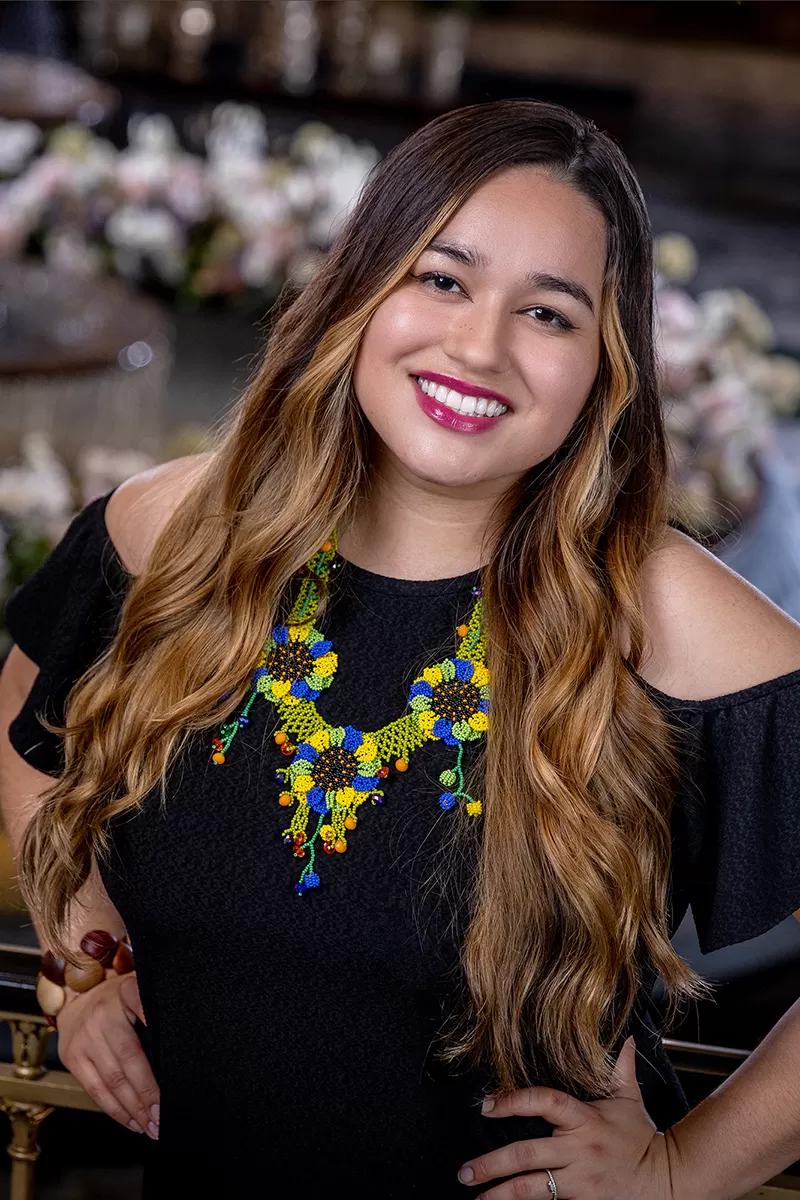
For Nadine Rios-Rivas, there is magic in the design and process of place. It is in the intentionality of iconography, in the expression of materials, and in the ability to harness readability and purpose of a project through architectural language that communicates the spirit of a building. She believes in the power of design, but to her it is less about the style or the prominence of a building and more about the collective wisdom that is shared when going into a project ready to learn, where the community is invited to engage in dialogue with designers early in the process.
“I have seen how powerful design can be when everyone gets to sit at the table,” Rios-Rivas said. “Part of the way we succeed in our business is by improving communities and there is the trickle effect of pricing people out, so I often struggle with the economics of it, but where I’ve seen it work, where the magic is, is in the early design process. When we sit and we listen and hear people express their concerns, their fears, their history; when we do the research and can honor their values, and we ask, ‘This is our perception, but does this actually fit your story?’”
Rios-Rivas is an Architectural Designer at TowerPinkster and an Adjunct Professor of Design Practice for Interior Architecture and Design at Western Michigan University’s Richmond Institute for Design and Innovation in Kalamazoo, Michigan. She also serves as co-director for the Project Pipeline Kalamazoo satellite program of the NOMA Detroit Chapter along with local architectural designer, Hayward Babineaux, Assoc. AIA, NOMA. She noted growing up in a multi-generational, multi-cultural home—and as an army kid—she has been fortunate to have had the opportunity to be exposed to different communities and cultures but doesn’t have the traditional path to architecture like that of most of her peers.
“I didn’t meet an architect until I was 20 years old—and it was after I had dropped out of a pre-med international relief program. I come from a missionary, medical-type family and that felt like the only option and didn’t really know about this industry until my dad was like, ‘Hey, you should look into architecture,’” Rios-Rivas said.
“I had gone home to where my parents were at the time, stationed in Germany, and met an architect in Nuremberg. I went to his firm and there was an intern who took the time to connect with me, full of energy, and showed me a project she was working on and she’s like, ‘They are pouring the foundations right now, do you want to go see?’ Seeing the design become the built world is when it clicked, all those buildings I have beautiful memories at, I’ve traveled to—I’ve gone to over 20 countries—I thought about how much effort and intention was put before the actual experience of the building and I got intrigued,” Rios-Rivas added.
Rios-Rivas attended Andrews University, a nationally ranked, global university in Berrien Springs, Michigan—based on its international student population and as the flagship school of the Adventist church—introducing her to a new way of learning, which she really enjoyed. Instead of studying for quick memorization, architecture school allowed for time to ideate and sit with projects with its studio-based structure, where she could invest and grow and collaborate with others.
“I liked that longer process of feeling like you completed something and specifically at Andrews University, it is a very international school, and I was intrigued by that. In my class, I had friends from Singapore, Cayman Islands, South Africa, and Canada, who brought their own perspectives on design and architecture. For example, in Singapore, there is not a lot of land, they have to build up, and the climate is different. It really opened my mind to how international and how different the field can be,” Rios-Rivas said.
“I liked drawing, I liked doing art, so I liked that connection of architecture, but I felt secure about choosing this as my career path during my fifth year master’s program. We worked with the municipality of Durban in South Africa. We studied the apartheid systems, and read the manifestos from the urban designers that used talent to oppress to learn about the history we were stepping into,” Rios-Rivas added.
During her graduate work, Rios-Rivas said her class, along with their professor, Andrew von Maur, traveled to Umbumbulu, South Africa and put an ad in the paper inviting the community to engage in the design process. She said they learned about the 40-40-40 system that placed communities of people 40 kilometers from opportunity for employment, gave them 40 square meters of places in which to live, and then 40 percent of their income would go back to the city for transportation, keeping them in poverty.
“The extent of our responsibility as designers is something I didn’t really think about until being exposed to this project. After our first community input, we learned how people walked for hours just to be a part of it because they had never been invited before, projects had always been given to them,” Rios-Rivas said.
“Just seeing that communication and connection of yes, we’re designers coming in, but von Maur specifically was like, ‘We don’t know what we don’t know, and you have to always go into a project, especially projects like that humbly, ready to learn, and hear what their needs are.’ They might not know how to express their needs as it applies to design. We carry the responsibility, because we have the design language and when we listen to their story, the puzzle comes together. If we are not listening to what those needs are, we won’t be able to give them a good project. That put a big fire in my heart,” Rios-Rivas added.
Rios-Rivas has worked at firms like Kingscott Associates Inc. of Kalamazoo, a firm known for its work in K-12 schools, commercial buildings, and senior living communities; and Byce & Associates Inc., which has since joined Abonmarche, and reconnected her with more community-focused work; before spending four years with Bodwé Seven Generations A+E in Michigan. It was at the latter she felt she was able to connect back to the social justice aspect of architectural design work and had the chance to work with Indigenous tribes in different states, like the boarding school project they were hired to do through the Bureau of Indian Affairs.
“We talked with the elders and the principals and learned on day three that they had been asking for a new school for like 20 years, so the people who first had the fire for it had passed or they had retired and so someone else was carrying that torch. We listened to their story, we had an open session where community members could come in—not just the stakeholders, which is the usual design process with schools—and really got to learn about the history and the meaning of why they were there,” Rios-Rivas said. “We learned about the Navajo Nation, the hogan—which is their traditional home with the door always focused east to signify life entering with the rising sun—and how there was an order to how you sat when they had ceremonies or meetings.”
The order would place the youngest to the immediate left of the doorway and as an individual aged, their place would rotate around the traditional structure as older generations exited out of the hogan from the right of the threshold as they passed on. Rios-Rivas said some of those principles were then incorporated into the design of the school so that the main entrance faced east and as the kids graduated, they would move in that clockwise, hogan-inspired pattern. The project also introduced dormitories, a cafeteria, and other programmatic needs into the school, which was also designed to look like the symbol of their school: a scorpion.
She has worked on projects with the Seventh-day Adventist Church that would also serve as a community-based project for First Nations communities in Canada, which emphasized for her the importance of communication and coming together to find creative solutions when navigating culture and good intentions. The result was pivoting from a funerary-based community center the church would also use, to offer health-based services like a diabetes program that would recognize the church’s desire to remain substance-free.
“Now, all of a sudden, the tension of, ‘We were promised this, but now it is not going to really work,” shifted and it was, ‘What other community needs can be met through the building?’ The ability to communicate and harness that communication into the purpose and the spirit of the building is where that magic happens,” Rios-Rivas said.
Today, Rios-Rivas works on mixed-use residential and commercial buildings—currently designing her dream project that really triangulates community, tenant visitor, and resident—and volunteers with Communities In Schools, NOMA, and the American Institute of Architects, or AIA, in her spare time. That dream project, the “B on Burdick” apartment complex in Kalamazoo, features 85 mixed-use units—20 of which are reserved for hospital employees—and realized in collaboration with Jamauri Bogan, founder and chief executive officer of Bogan Developments. And her passion outside of work continues to be the NOMA Project Pipeline Kalamazoo summer program.
“NOMA is all about handing the torch down to the next generation. It started with the first Black licensed architects in the 1970s with a mission to bring their community to the field. Today, NOMA is leading the work in elevating and encouraging all minorities to be present within architecture, but everybody and anybody is welcome. Project Pipeline is a three-day camp and for me, personally, it’s important because I didn’t meet an architect until I was 20 years old. I question if I would have even tried pre-med had I experienced this when I was younger, and I often hear people say they get into design because of a parent in the industry or they took a CAD class in school. I think those opportunities are getting better now, but for minorities and underprivileged communities, they might not have that access or route in,” Rios-Rivas said. “I love this camp because it allows students to get excited about higher learning regardless of the field they will enter; of course, we hope we plant the seeds for our industry.”
It was also through Project Pipeline Kalamazoo that Rios-Rivas built a relationship with the local academic community at WMU—since one of the requirements is that the program is held in an education space—and was invited to teach a freshman class on design communication. It is a part-time role she discovered she loves, particularly when the lightbulb moment goes off for a student in how the tools and language of design can be communicated through paper and the physical world.
“In order to design well, with intentionality, you need to be able to communicate that through the expression of materials, through those little magical moments like a doorknob giving you a handshake into a building—a quote I read—and so that is the magical part we as professionals can bring to the table, and I tell that to my students,” Rios-Rivas said.
For Rios-Rivas, challenges in the industry, like the “elephant in the room” that most architects and designers are artists who don’t get paid enough, and how to differentiate the humanity of design from a computer—the stories that people can write that only humans can really understand—remain, but she holds a hopeful curiosity for the future. Perhaps projects will require teams of designers from different firms to come together around an ideation or a design and then disperse once a project is completed; or there will be more of a broader community-based mentality where industry creatives mentor others, share their wisdom, and pass on that torch to the next generation.
“Don’t let that die with you, find somebody to pass that information onto,” Rios-Rivas said. “I think that will make us better in the industry as a whole.”
Rios-Rivas, whose passion for the field emerges like the very fire she felt ignited back in graduate school, can find the beautiful moments in materials, in expression, in buildings, in collaboration, and in the potential of design for a better world. She has a love of form-based code and recognizes the patterns and repetitive motifs that have existed in built spaces and historical landmarks that came long before.
“I think humanity is yearning and seeking good design and good pockets to feel comfortable and safe. We see it past our western history, where temples in the jungles of India and the Amazon are being discovered—ziggurat-like structures—this is not new, it has always been with us, we have always wanted place,” Rios-Rivas said.
“One of the first things I learned in the Architecture Program was about Vitruvius and his pillars of architecture—utilitas, firmitas, and venustas—utility, firmness, and delight: is it structurally sound? Is it going to fall? Is it functioning? Is it utilizable? Is it going to work for what the purpose is? The beauty my eyes behold is when the building can become a gift to the community, with its aesthetic exterior but more importantly when the neighborhood is welcomed in to stay and make memories within the building. This is what I see as the heart of the B on Burdick. Our community Living Room space,” Rios-Rivas added.